
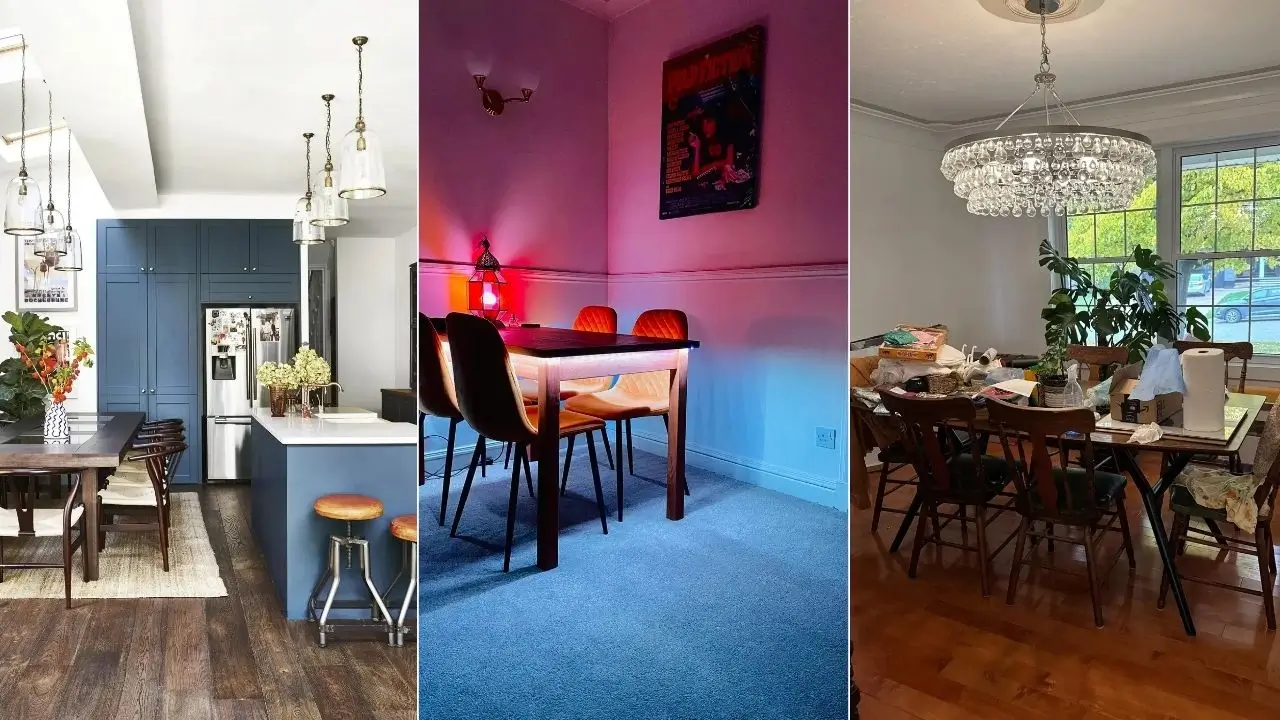
The wrong light fixture can make a beautiful dining room feel like a waiting room at a dentist’s office. Getting it right, though? That single choice can transform an ordinary meal into something that feels intentional and warm.
I’ve pulled together eight real-world examples actual homes, actual choices, real results so you can see how different approaches to dining room lighting ideas play out beyond the pages of a design magazine.
These aren’t staged shoots with unlimited budgets. They’re real spaces where people made decisions and lived with them.
Let’s get into it.
Clustered Glass Bell Pendants Over an Open-Plan Kitchen-Dining Space
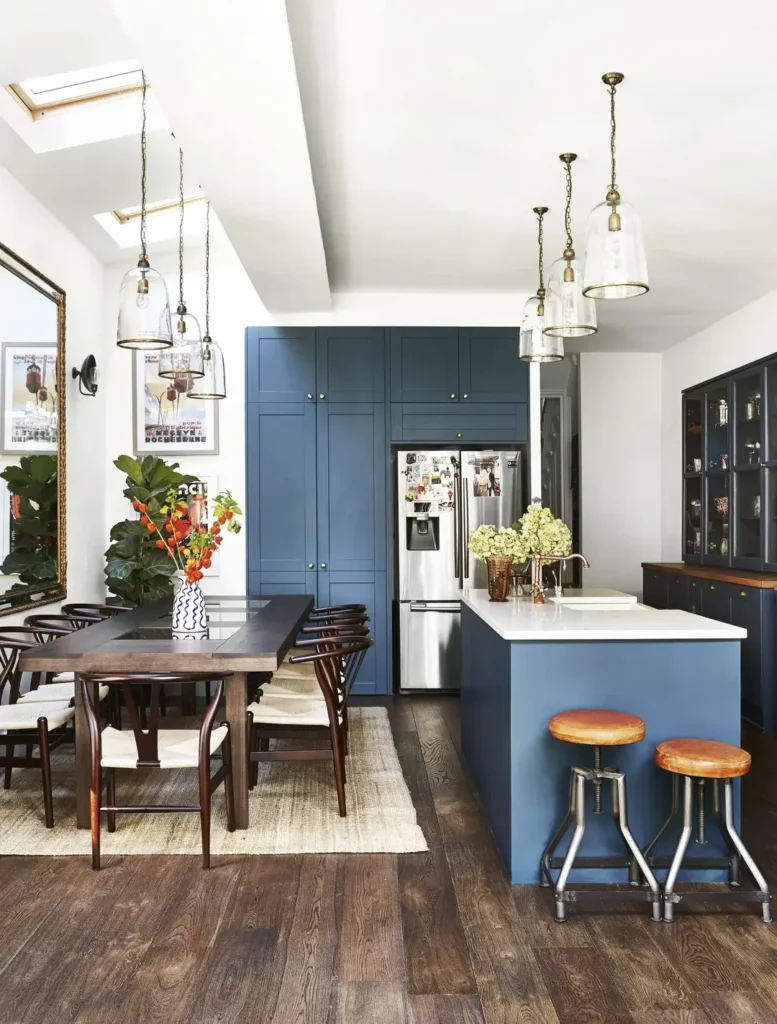
There’s something clever happening in a kitchen-dining setup when the lighting does double duty without calling attention to itself.
r/ManiaforBeatles shared this open-plan space where two clusters of clear glass bell pendants hung on antique brass chains anchor the dining table on one side and the kitchen island on the other.
The pendants are simple in shape: dome-topped, clear glass, with visible Edison-style bulbs inside. The brass hardware reads warm against the otherwise white ceiling and walls, and the asymmetrical clustering (three over the dining area, three over the island) creates visual rhythm without requiring matching fixtures.
What makes this work is the tonal consistency. The brass hardware ties directly into the kitchen cabinet knob hardware and the industrial-style bar stools with their warm tan leather seats.
Nothing is matchy-matchy, but everything belongs to the same family. The dark walnut dining table and wishbone-style chairs ground the space without competing with the light fixtures overhead.
If you’re working with an open-plan kitchen and dining area, this approach offers a lesson worth stealing: use the same fixture family in both zones rather than switching styles.
It creates cohesion across a large space without requiring identical pieces. The clear glass keeps the room feeling airy a solid consideration when natural light comes primarily from skylights rather than wide windows.
One practical note: pendants hung over a dining table should sit roughly 30 to 36 inches above the tabletop. These look to be in that range, which keeps the light focused on the surface without glaring into seated guests’ eyes.
Triple Woven Rattan Pendants for a Bohemian Breakfast Nook
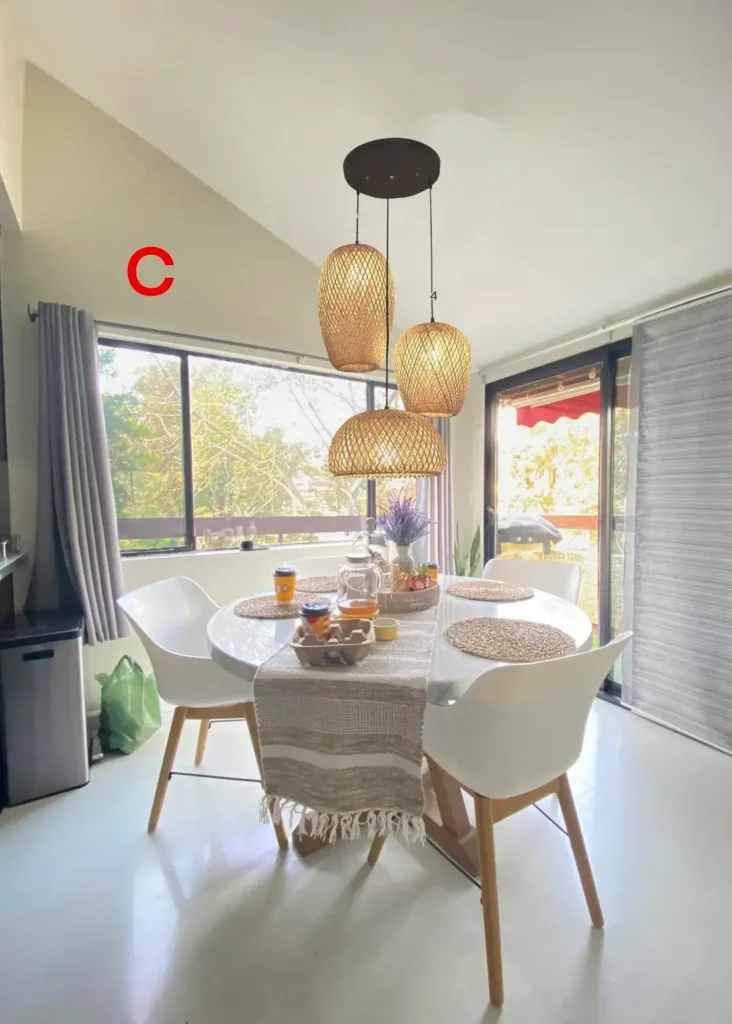
Natural materials in dining room lighting have had a moment for the past several years, and this setup explains exactly why they keep showing up.
r/DesignMyRoom chose a cluster of three woven rattan pendants all hung from a single ceiling canopy — over a round white table near a large corner window.
The pendants are ovoid in shape with an open lattice weave, which means light passes through in soft, diffused patterns rather than casting a single hard pool.
The warm glow from the bulbs inside picks up the natural honey tone of the rattan and bounces gently off the white table surface.
This works because of contrast. The organic, handwoven texture of the fixtures sits directly against clean white modern chairs with natural wood legs a pairing that feels effortless rather than forced.
The woven jute placemats on the table echo the rattan material overhead, which creates a quietly layered look without any single element fighting for dominance.
For smaller dining spaces or breakfast nooks, a single-canopy multi-pendant cluster is one of the most effective approaches you can take.
It reads as one cohesive fixture rather than three competing ones, and it scales well with round tables. The varying drop heights of the three pendants here each hung at a slightly different length add movement and visual interest that a single flat chandelier wouldn’t achieve.
Keep in mind that woven rattan produces beautifully patterned shadows on walls and ceilings when the surrounding lights are dim, which adds a secondary layer of atmosphere you don’t get from glass or metal shades.
A Brass Candelabra Chandelier in a Traditional Dining Room
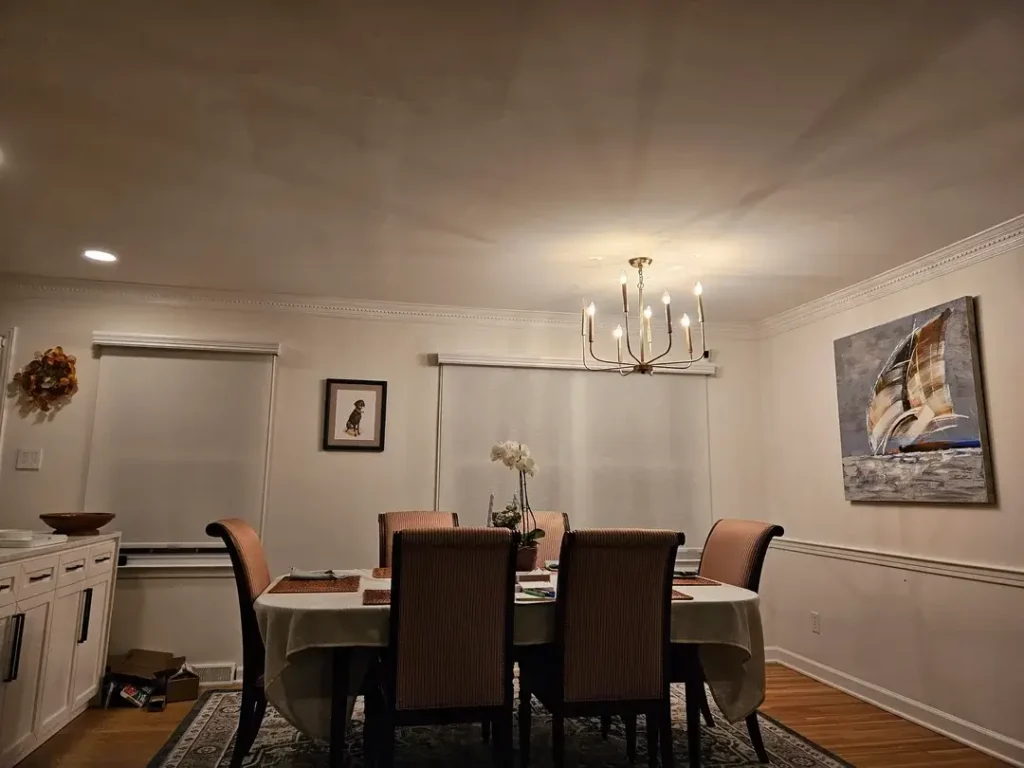
Some dining room lighting ideas don’t need to reinvent anything they just need to be done well.
r/i_have_a_qstion_plz shows a formal dining room anchored by a six-arm brass candelabra chandelier with slim candle-style bulbs.
The fixture hangs centered over an oval table dressed with a neutral linen cloth, white orchids as a centerpiece, and striped upholstered dining chairs in muted terracotta tones.
Crown molding frames the ceiling, and white roller shades on the windows keep the background clean.
What’s notable here is the warmth of the evening atmosphere. This photo was taken at night, and the chandelier is clearly doing most of the ambient work.
The recessed light in the corner of the ceiling suggests a layered lighting scheme is in play, which is worth replicating.
A chandelier alone rarely distributes light evenly across an entire dining room the recessed or wall sconce addition handles fill lighting while the chandelier creates the focal point.
The chandelier height here looks slightly low for the ceiling height, which is actually a deliberate choice in traditional dining rooms.
Dropping a fixture closer to the table creates intimacy. The general rule is 30 to 36 inches above the table surface, though in spaces with standard 8-foot ceilings, designers sometimes push it to 28 inches for formality.
If you’re drawn to the candelabra style, look for fixtures where the arm construction is clean and geometric rather than overly ornate it keeps the look from aging into something fussy. The slim brass arms here strike that balance well.
An Oversized Crystal Drop Chandelier That Owns the Room
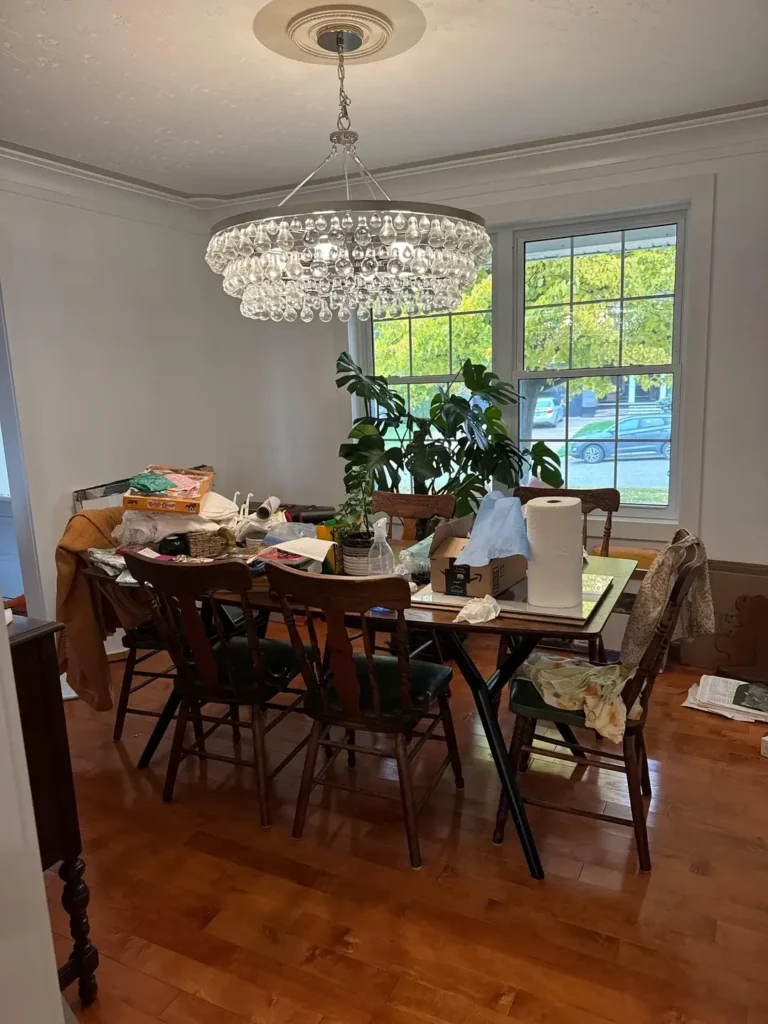
This one surprised me. Not because crystal chandeliers are unusual, but because of where it landed.
r/NickelbacksNo1Fan installed a large circular crystal drop chandelier in what appears to be a transitional-style dining room with warm honey oak flooring, white crown molding, and a large double-hung window overlooking mature trees.
The fixture itself is substantial multiple tiers of faceted glass teardrop pendants arranged in concentric rings on a circular chrome frame. It’s the kind of piece that immediately communicates “this was not an afterthought.”
The room itself is, let’s say, mid-transition the table is covered with boxes and general life chaos, which the original poster acknowledged.
But the chandelier doesn’t care. It sits there looking composed while everything below it does not. That’s actually a useful illustration: a strong overhead fixture can hold a room together visually even when the rest of it is in flux.
Crystal chandeliers scatter light in ways other materials don’t. Faceted glass breaks light into tiny prismatic points that travel across walls and ceilings, which adds energy and movement to a space even with bulbs at moderate brightness.
Paired with a dimmer (which I’d consider non-negotiable for any dining room chandelier), you can shift the mood dramatically without swapping fixtures.
Sizing is where people go wrong with statement chandeliers. A quick rule: add the room’s length and width in feet, and that number in inches is roughly the right chandelier diameter.
For a 12×14 room, that’s a 26-inch fixture as a starting point. The piece shown here looks to be 36 inches or larger, which reads boldly and intentionally rather than undersized and timid.
A Drum Shade Pendant Over a Glass Round Table
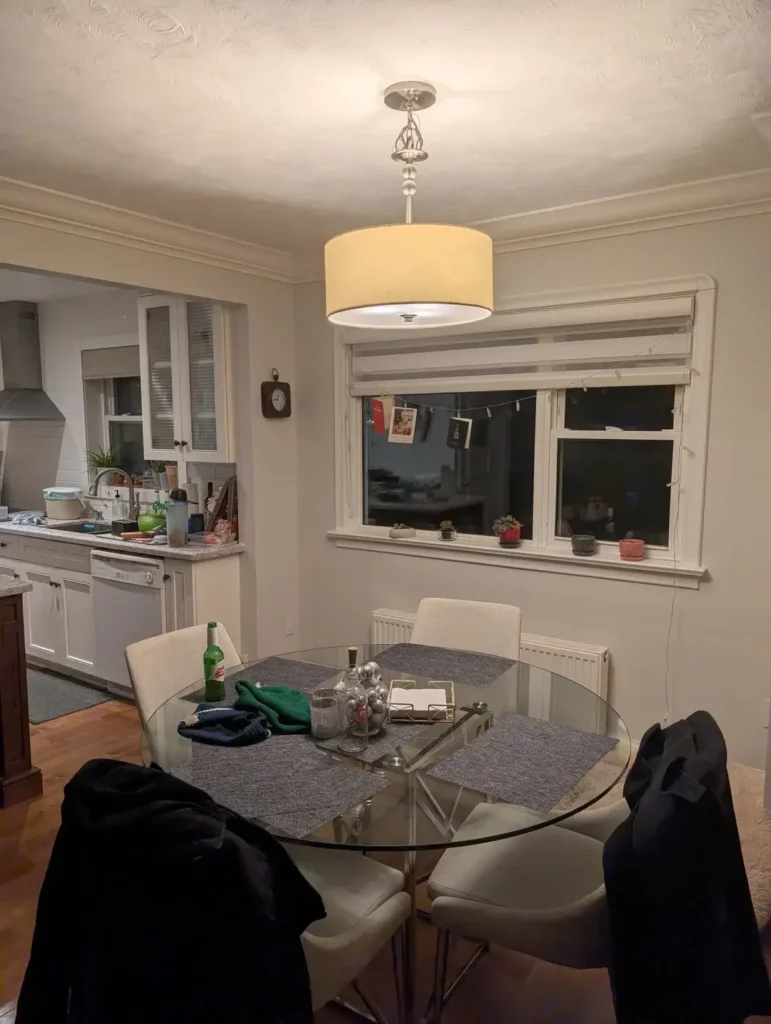
Not every dining room needs a statement piece sometimes a well-proportioned, quietly competent fixture is exactly the right call.
r/diablotom2 shares a compact kitchen-dining space where a cream fabric drum shade pendant hangs centered over a round glass table with chrome X-frame base and white upholstered chairs.
The fixture has a silver decorative fitter and stem with a small crystal element at mid-point a subtle detail that elevates it past a plain drum without tipping into formal territory.
What this setup demonstrates well is the relationship between a glass table and overhead lighting. Glass surfaces reflect light from above, which means the distribution of light in the room is effectively amplified in a subtle way the tabletop becomes a secondary reflective surface.
This makes a single pendant feel more effective than it might over a solid wood surface, because the light bounces back upward into the space.
The drum shade produces a soft, even glow rather than direct downlight, which flatters faces at the table and creates a relaxed atmosphere.
For everyday dining spaces ones that live between formal and casual this type of fixture is forgiving and versatile. It doesn’t demand a particular decor style and works well in transitional or contemporary interiors.
One thing I’d push back on slightly: the fixture here reads a touch small for the ceiling height. A wider drum say, 18 to 20 inches rather than what appears to be 14 to 16 inches would command the space with more confidence without changing the fundamental approach. When in doubt, size up.
A Builder-Grade Chandelier Asking for an Upgrade
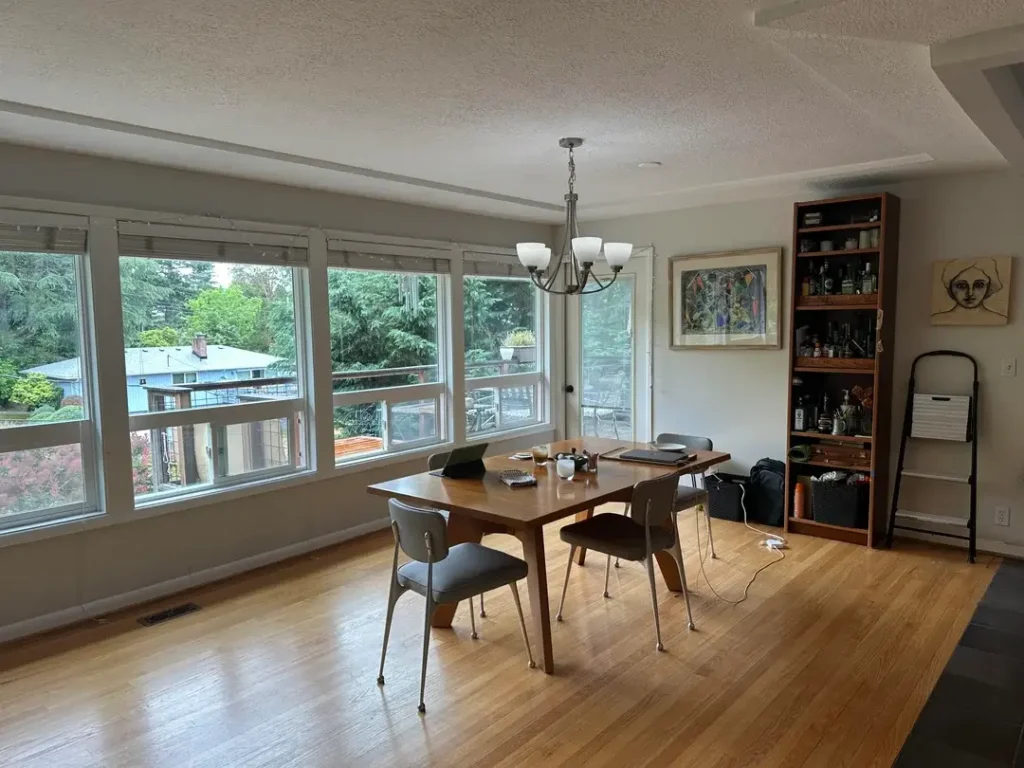
This one is included not because it’s aspirational but because it’s honest and recognizing the problem is the first step.
r/adcom5 posted this light-filled Pacific Northwest dining room with generous windows on two walls, warm maple hardwood floors, and a mid-century modern walnut dining table.
The room has real bones. What it has over the table, though, is a small, brushed nickel chandelier with frosted glass shades in a style that would have been completely unremarkable in 2007.
Against the well-composed room around it, it reads as a fixture that was simply left in place rather than chosen.
This is one of the most common dining room lighting problems: the fixture came with the house, it works fine technically, and changing it feels lower priority than other upgrades. The result is a room that almost lands but doesn’t quite commit.
The contrast here is useful. The warm maple floors, the bookcase full of character, the nice framed artwork — all of it creates a personality. The fixture has none.
A simple replacement with a statement chandelier in a matte black or dark bronze finish with cleaner lines would bridge the mid-century furniture and the relaxed character of the space.
If your dining room looks like this great bones, forgettable light the single highest-return design move you can make is swapping the fixture. You don’t need to renovate. You don’t need new furniture. You need a fixture that was actually chosen rather than inherited.
Under-Table LED Strip Lights With a Moroccan Table Lamp Accent
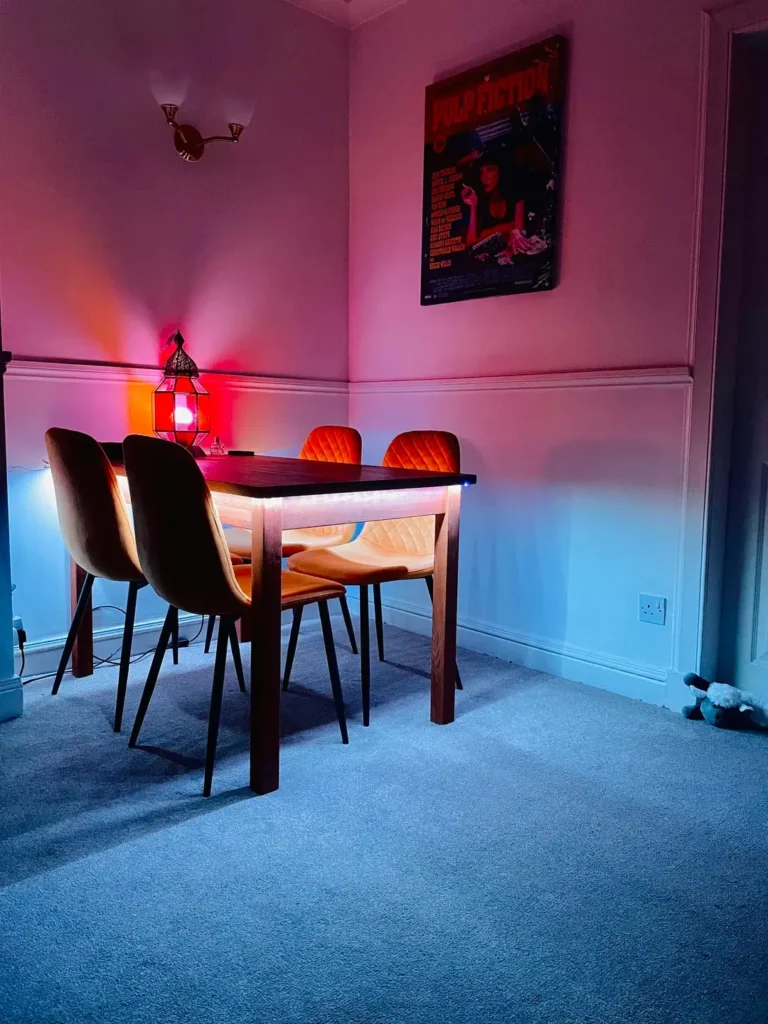
This is the one that either speaks to you immediately or doesn’t, and I respect both responses.
r/fitbawpatter created a dining space that commits fully to its vibe: warm orange LED strip lights mounted to the underside of a dark walnut dining table edge, a faceted red Moroccan-style geometric table lantern in the corner glowing at red-orange, and what appears to be a smart bulb wall sconce behind it cycling blue.
The result is a room bathed in shifting warm and cool tones with the dining table literally glowing from below.
The velvet-upholstered dining chairs in burnt orange pick up the warm light tones perfectly. The Pulp Fiction poster on the wall tells you exactly what kind of atmosphere this person was building cinematic, moody, deliberate. And it works on its own terms.
From a practical standpoint, LED strip lights under a dining table are a legitimate dining room lighting idea that rarely appears in design content but shows up in real homes.
The warm white or amber version creates a floating effect without the dramatic color play shown here. For those drawn to ambiance over task lighting and who don’t eat at their dining table so much as host late-night gatherings around it this approach creates atmosphere that no chandelier can replicate.
The key, if you pursue this approach, is keeping the accent lighting intentional. Random RGB strips in multiple clashing colors would read as a dorm room.
Here, the orange and blue create contrast that feels composed rather than accidental, though it’s admittedly a high-risk approach that depends entirely on your personal aesthetic.
A Linear Crystal Chandelier Over a Farmhouse-Modern Dining Table
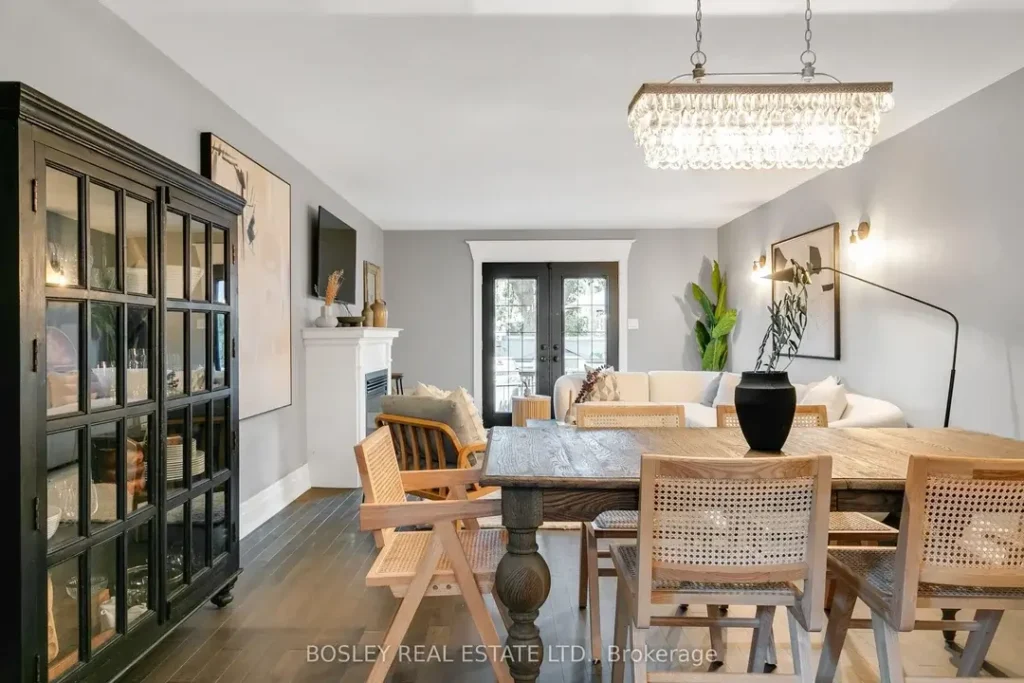
The rectangular chandelier over a rectangular table is a design pairing that’s difficult to get wrong when both pieces are this well-matched.
r/Longjumping-Dog8577 shows a dining room where a linear crystal chandelier in an antique brass rectangular frame hangs over a reclaimed oak dining table with turned pedestal base and cane-back chairs.
The fixture has the same teardrop glass-drop construction as a round crystal chandelier but in an elongated rectangular silhouette that mirrors the table below.
The proportion is nearly perfect the fixture appears to be roughly 60 to 70 percent of the table’s length, which is the standard design guideline.
The room around it earns its keep. Dark hardwood floors, a massive black steel-framed display cabinet against the left wall, soft gray walls, and French doors at the far end create a layered backdrop.
The gold arc floor lamp in the living area visible beyond adds warmth to the background. Wall sconces with aged brass fittings complement the ceiling fixture without duplicating it.
What I find most instructive about this image is the layered lighting approach. The chandelier is the primary fixture, but it isn’t alone.
The sconces on the right wall, the floor lamp in the adjacent space, and presumably some recessed lighting all work together. Dining room lighting ideas work best when they’re part of a system, not a single solution.
The cane-back chairs and reclaimed wood table give the space warmth and texture, and the crystal fixture adds formality without tipping the room into stuffy territory.
It’s a balance achieved by mixing refined materials (crystal, brass, dark stained floors) with organic ones (cane, reclaimed oak, natural plant), and the lighting holds that tension gracefully.
Choosing the Right Fixture: A Quick Reference
| Fixture Style | Best For | Room Size | Mood Created |
|---|---|---|---|
| Glass bell pendants (clustered) | Open-plan kitchen-dining | Medium to large | Modern, airy, eclectic |
| Woven rattan pendants | Breakfast nooks, casual dining | Small to medium | Bohemian, warm, natural |
| Candelabra chandelier | Formal dining rooms | Medium to large | Classic, intimate, traditional |
| Crystal drop chandelier (round) | Statement rooms | Medium to large | Glamorous, dramatic |
| Drum shade pendant | Everyday dining, transitional style | Small to medium | Relaxed, versatile |
| Standard chandelier (builder-grade) | Temporary or rental situations | Any | Functional only |
| LED strip + accent lamps | Entertainment-focused dining | Small to medium | Cinematic, atmospheric |
| Linear crystal chandelier | Farmhouse-modern, open dining | Large | Elevated, layered |
The Fixture Is the Furniture
Every one of these spaces reminds me that dining room lighting ideas aren’t decorative details they’re structural decisions.
The fixture you choose sets the ceiling for how good the rest of the room can look. A mediocre fixture in a well-decorated room will drag the whole thing down. A strong fixture in an otherwise average room pulls it upward.
The common thread across the examples that work best the bell pendants, the woven rattan cluster, the linear crystal over farmhouse oak is intentionality.
The fixture was chosen to match the room’s character, not just its ceiling junction box. Scale was considered. Materials were connected to the furniture below.
And the examples that fall short, like the builder-grade chandelier in the otherwise lovely Pacific Northwest space, show what happens when the fixture is simply never questioned. It’s a small change with a disproportionate return.
Whichever direction your space is heading, the question to ask isn’t “does this fixture work?” It’s “does this fixture belong here?” The difference between those two questions is the difference between a room that functions and one that’s genuinely worth sitting in.