
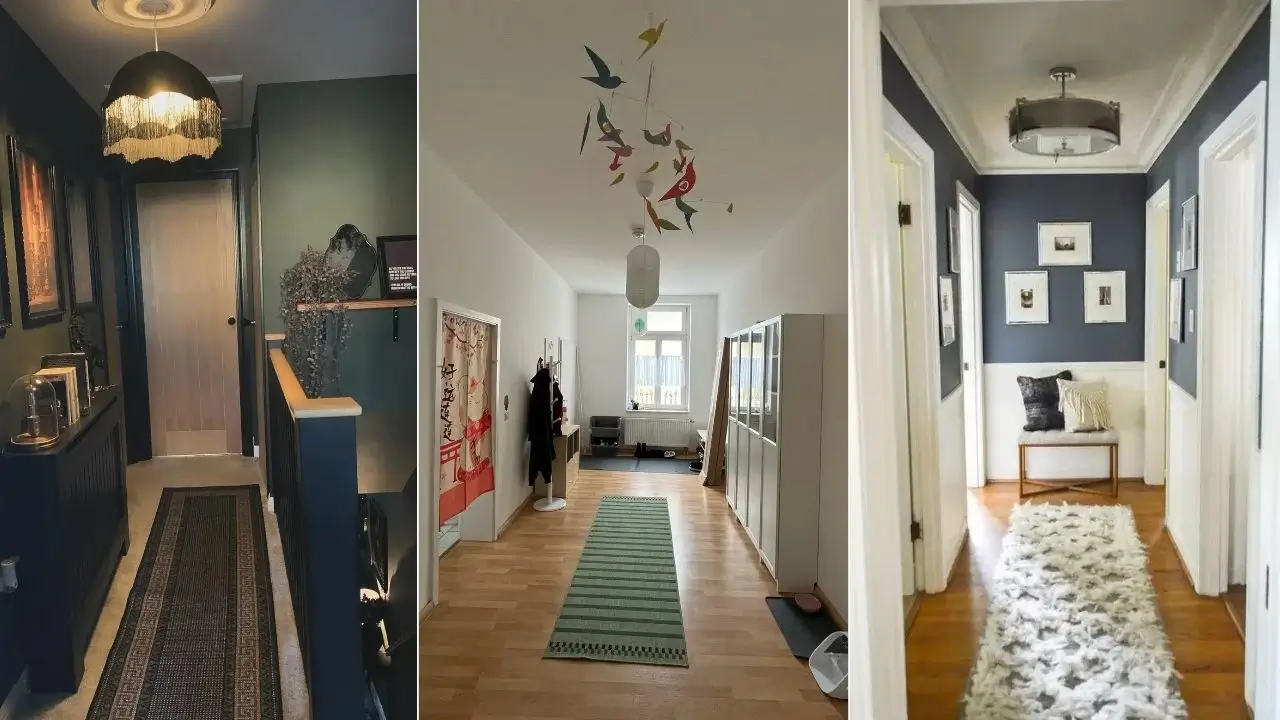
Let’s be honest. Your hallway is probably the most ignored space in your entire home. You walk through it a dozen times a day, never stop, never look around, and definitely never think “wow, this could be gorgeous.” But here’s the thing, it absolutely could be.
Long hallways are secretly one of the easiest spaces to transform. A runner here, a statement light there, maybe a coat of bold paint on the doors, and suddenly that forgotten corridor looks like something out of an interior design magazine. No architecture degree required.
I dug through real homeowner examples, the kind of stuff people actually share on Reddit after a weekend project, and pulled together ten ideas that genuinely work. I’m also breaking down why they work so you can steal the concept, not just the aesthetic.
Let’s get into it.
A Persian Runner + Sputnik Fixture = Instant Personality
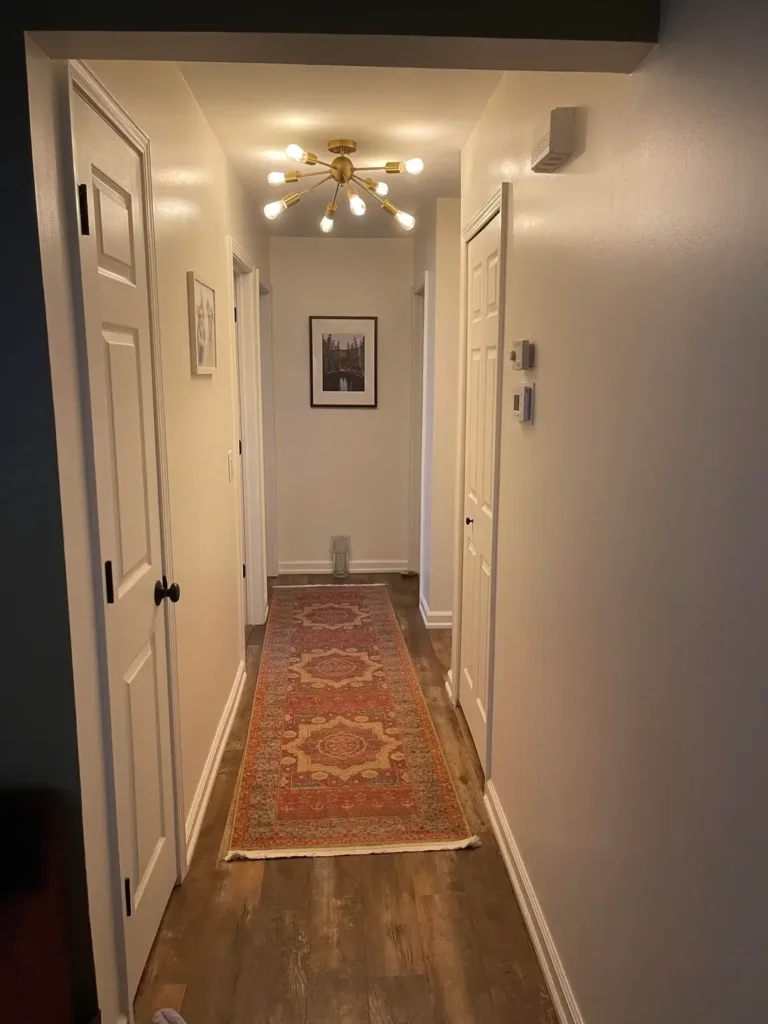
Sometimes the simplest combinations hit the hardest. Two pieces. That’s the whole trick here.
Warm medium-tone hardwood floors. A faded Persian-style runner in rust, ivory, and muted blue. A brass sputnik chandelier with Edison bulbs hanging overhead. One black-and-white photo anchoring the far wall. That’s the entire setup, and it looks incredible.
Why it works: The rug and the fixture share warmth without looking like a matching set. The rust tones in the runner echo the gold in the chandelier in that “accidental-on-purpose” way that takes way more thought than it looks like.
Want to recreate this? Here’s how:
- Start with the runner. A Persian-style or distressed Oriental rug anchors the whole space instantly
- Pick a warm-finish ceiling fixture, brass, antique bronze, or warm gold all do the job beautifully
- Add black door hardware to tie everything together without introducing another color to manage
One practical note: make sure the rug stops before each doorway. A runner that disappears under a door just looks sloppy. Leave a few inches of clearance on each end and you’re good.
Black Doors + Diamond Runner = High-Contrast Magic
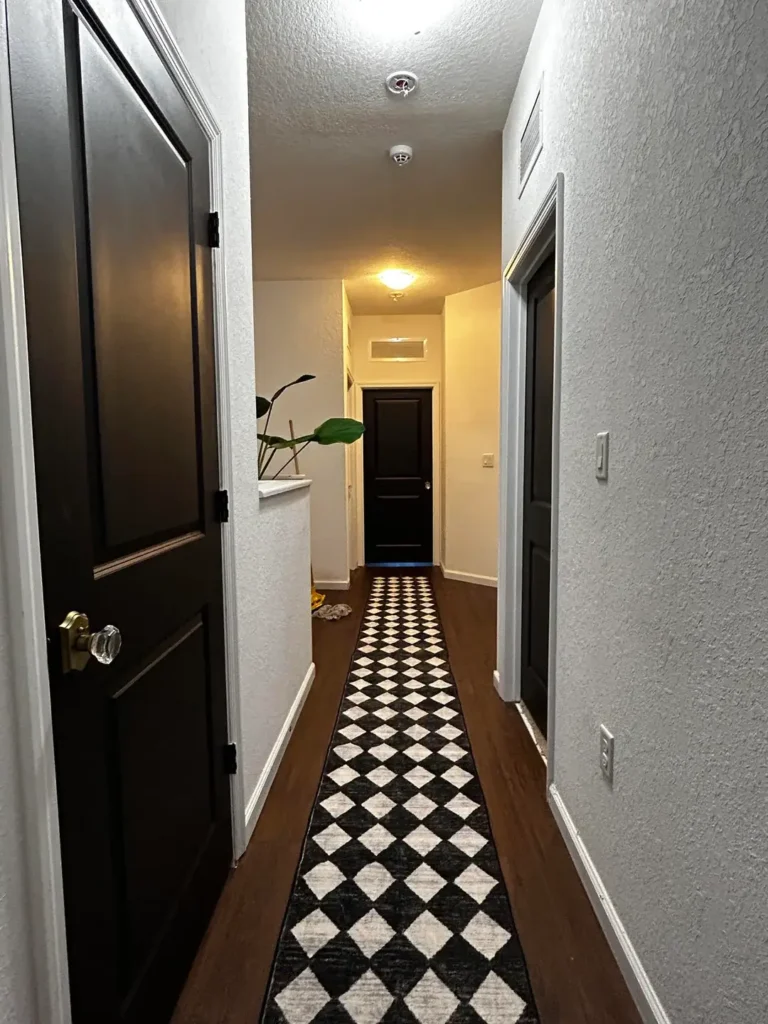
Most people see a plain white hallway and immediately start thinking about wall paint. This homeowner went in a completely different direction and honestly? Way smarter.
Every single door got painted deep matte black. Against cream-white textured walls, those doors look bold, graphic, and wildly intentional. A black-and-white diamond harlequin runner on the floor doubles down on the contrast without adding a single new color to the mix. One tiny leafy plant at the far end provides just enough softness to keep it from feeling severe.
The key lesson here is full commitment. One black door would look awkward. A soft neutral runner would kill the tension entirely. Half-measures would have ruined this.
Oh, and that crystal glass doorknob? Absolute chef’s kiss. A tiny moment of delicacy tucked inside an otherwise graphic, high-contrast scheme.
FYI, dark doors actually make narrow corridors feel more intentional, not more cramped. They add visual weight to the walls in the best possible way. Pair them with a runner that reinforces your palette, keep everything else simple, and drop a plant at the far end so the hallway doesn’t read like a tunnel.
Layered Runners + a Corner Console Solve the “Impossibly Narrow” Problem
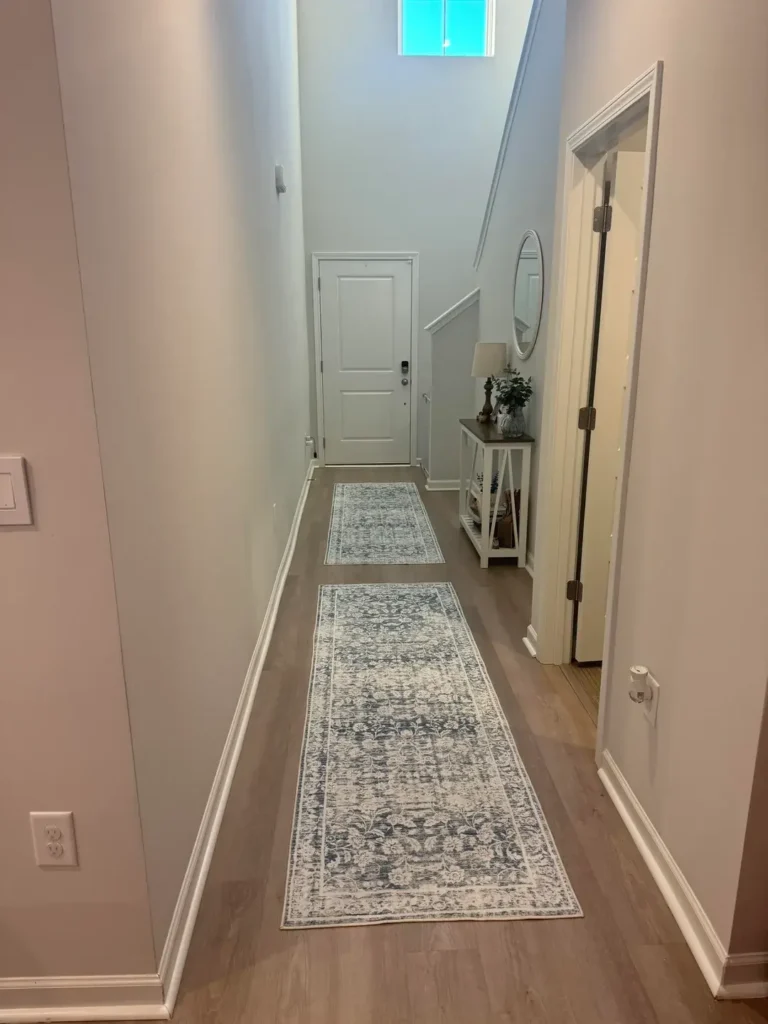
You know that hallway where you have to turn sideways to let someone pass? Yeah, we’ve all been there. This is the fix.
Instead of ignoring the narrowness, this homeowner leaned into it. Two matching floral distressed runners in slate blue and ivory run end-to-end down the corridor. The small visual break between them adds rhythm instead of making the space feel like one endless stretch. Near the entry, a white X-frame console table sits tucked against the wall with a small lamp, a vase of greenery, and a round mirror above it.
The real MVP here is the mirror. Turquoise-tinted natural light pours in from a skylight above the staircase, and that mirror bounces it right back into the space. Everything stays in soft, cool tones so the decor plays with the light instead of fighting it.
Pro tips for super narrow hallways:
- Use two shorter runners instead of hunting for one custom-length piece. Easier to find, easier to clean, and the visual break adds interest
- Stick with the same pattern and colorway for both runners so the space reads as one cohesive look
- A slim console table plus mirror near the entry turns an awkward dead corner into a proper welcoming moment
Also Read: How to Decorate a Long Hallway: 10 Real-Life Examples and Pro Tips
A Pendant Light + Eclectic Art Warm Up a Tall Traditional Entryway
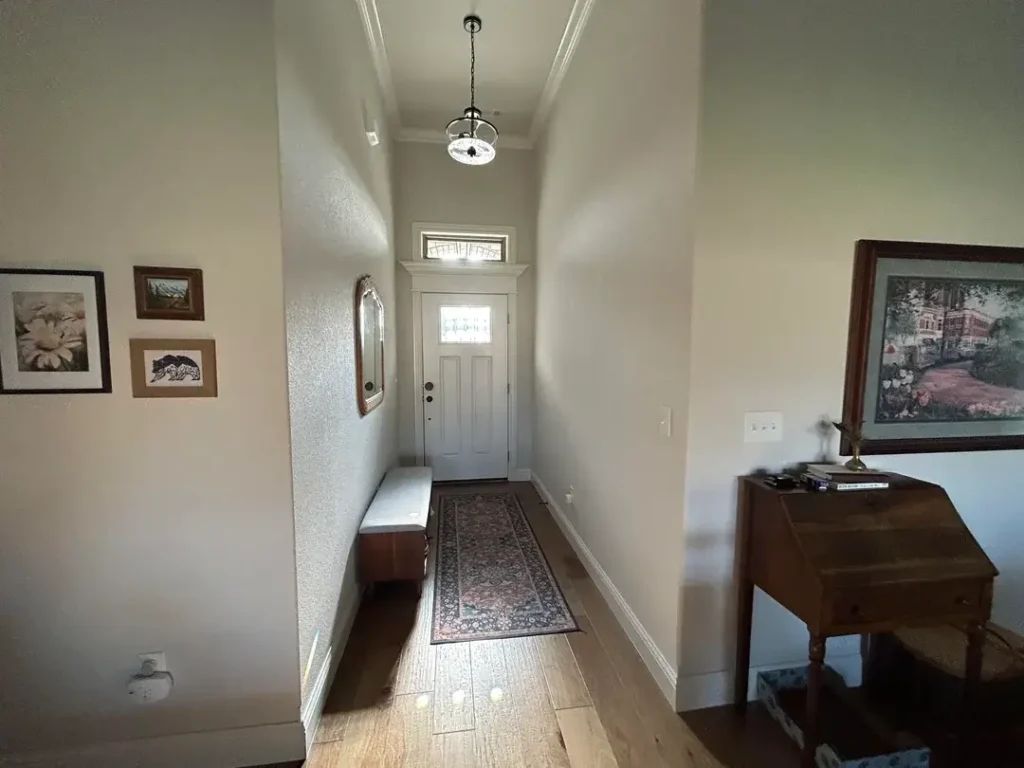
High ceilings in a hallway are a gift. Please, for the love of good design, stop ignoring them.
I see so many hallways with gorgeous ceiling height and absolutely nothing happening up there. This homeowner fixed that by hanging a vintage-style glass pendant that actually fills the vertical space. On one wall, three framed pieces hang in a casual cluster, a large floral close-up, a smaller landscape, and a botanical print. On the opposite wall, an oversized architectural print matches the scale of the room. A small upholstered bench sits near the front door beneath the pendant.
The warmth here comes from texture and layering, not expensive pieces. Textured walls catch light differently than flat paint. A warm walnut secretary desk peeks in from one edge, tying into the wood tones of the frames. Nothing screams expensive, but everything feels thought-through.
That bench also does double duty:
- It gives visitors somewhere to sit and remove shoes (functional win)
- It breaks up the long rectangular floor plane (visual win)
If your hallway has ceiling height, use it. Even one well-chosen pendant completely transforms how it feels to walk through the space.
Deep Forest Green Walls Build a Moody, Dramatic Corridor
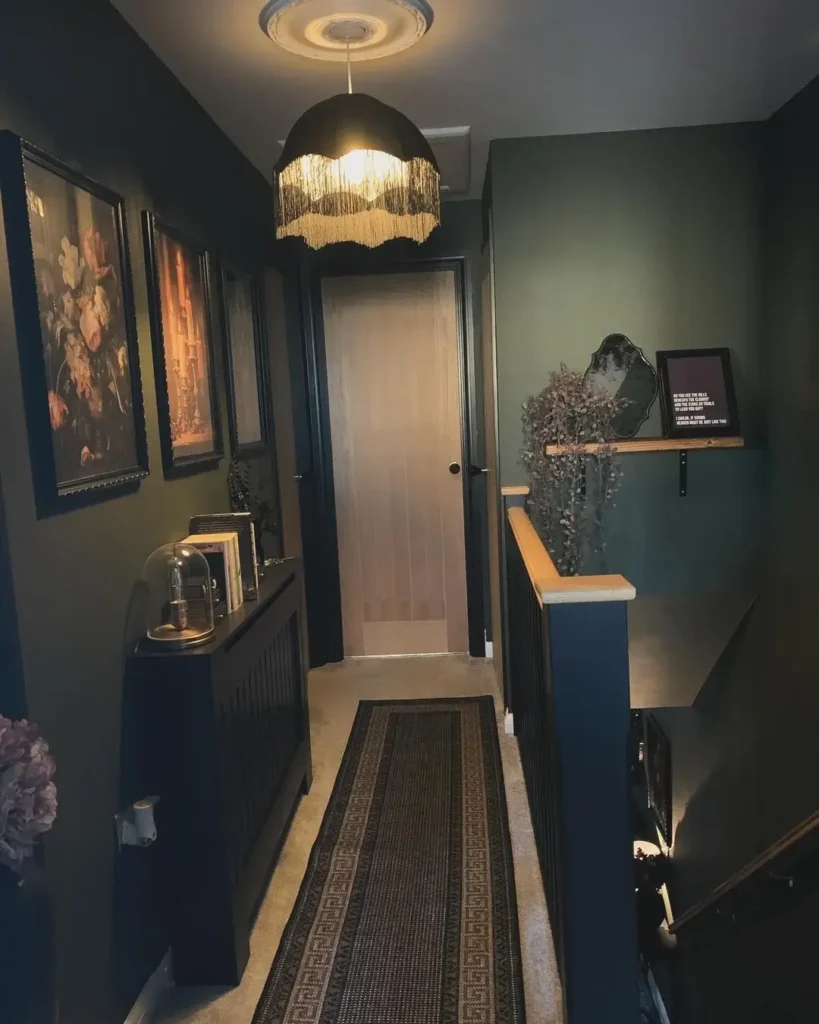
Going dark in a hallway sounds terrifying. This example proves it’s actually brilliant.
The walls are painted a deep forest green, think Farrow and Ball Smoke Green territory. Bold? Absolutely. But here’s the detail that makes the whole thing land: the ceiling is painted the same color.
That one decision transforms “dark hallway” into “enveloping, intentional space.” A dome pendant with brass fringe hangs from a decorative ceiling medallion, throwing warm moody light across richly framed oil paintings. A painted radiator cover doubles as a console surface. A floating shelf holds dried botanicals, a small ornate mirror, and a framed text piece.
This hallway knows exactly what it is. No identity crisis here.
If you want to try this approach:
- Commit fully, ceiling included. A dark wall with a white ceiling creates a visual chop that completely undermines the mood
- Choose a wall color with a botanical or mineral undertone, not flat grey or navy
- Invest in warm, diffused light sources. Harsh downward shadows will kill the vibe immediately
Wainscoting + Walnut Console + Oval Mirror = Wide Hallway Perfection
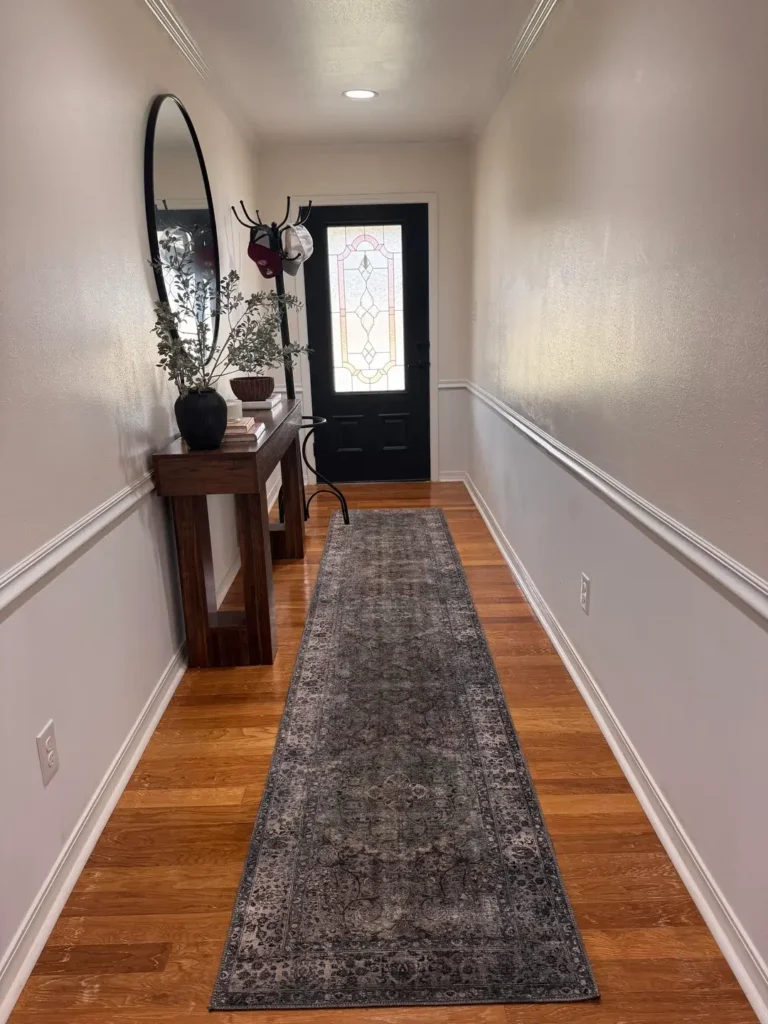
No windows? No problem, as long as you plan your lighting properly.
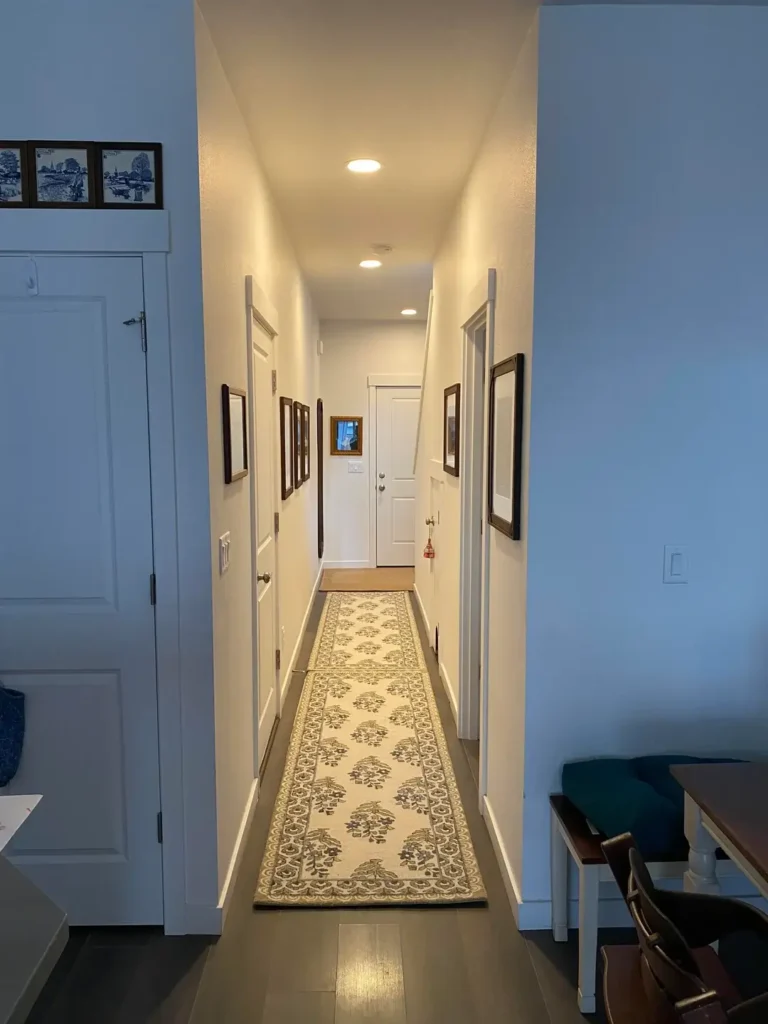
The most common long hallway complaint I hear is “it’s just so dark in there.” This homeowner solved it with evenly spaced recessed can lights along the ceiling, casting consistent warm light down the entire length of the corridor. On both walls, small-to-medium framed pieces hang in a loose gallery arrangement, art prints, photographs, and decorative tile pieces. Dark wood frames stand out cleanly against bright white walls. A cream-and-gold botanical runner ties into the warm lighting tones at floor level.
Here’s what recessed lighting does that a single overhead fixture can’t: it distributes light evenly so no section of the hallway feels dim or forgotten. Every piece of art stays readable from wherever you’re standing, which is kind of the whole point of hanging art in the first place.
If you’re dealing with a windowless hallway:
- Recessed lighting is worth every penny of the investment
- Pair it with a gallery wall so people have something to look at as they move through
- Keep frames in a unified finish, dark wood, black, or gold, so the collection reads as intentional even with different image types
- A patterned runner at floor level completes the layered look without needing anything else
Also Read: How to Style Your Hallway: 12 Lighting Setups for Every Budget
A Framed Gallery Wall + Recessed Lighting Fix the Windowless Hallway
Not every hallway is narrow. When you’ve got width, the challenge shifts completely.
This homeowner transformed a wide European-style corridor with high ceilings into something that feels like a curated passageway between rooms. The standout detail is a large Calder-style bird mobile hanging from the ceiling, colorful paper or fabric birds in teal, red, gold, and dark green suspended from a wire frame. A cylindrical white paper lantern below it handles the actual lighting. On one wall, a Japanese noren curtain in soft reds and pinks hangs in a doorframe, working as both a room divider and a textile installation. A slim coat rack and low dresser handle functional storage. A sage green striped runner anchors the center of the floor.
Ceiling decor is criminally underused in hallways. People default to one overhead fixture and call it done. But in a high-ceilinged space, the ceiling plane is prime real estate. A mobile adds movement and personality that static art simply cannot match.
IMO, this is one of the most creative hallway ideas on the entire list. Cultural textiles, a noren curtain, a woven wall hanging, an embroidered panel, add warmth and texture that printed art alone just can’t replicate.
A Ceiling Mobile + Cultural Textiles Turn a Wide Hallway Into a Living Space
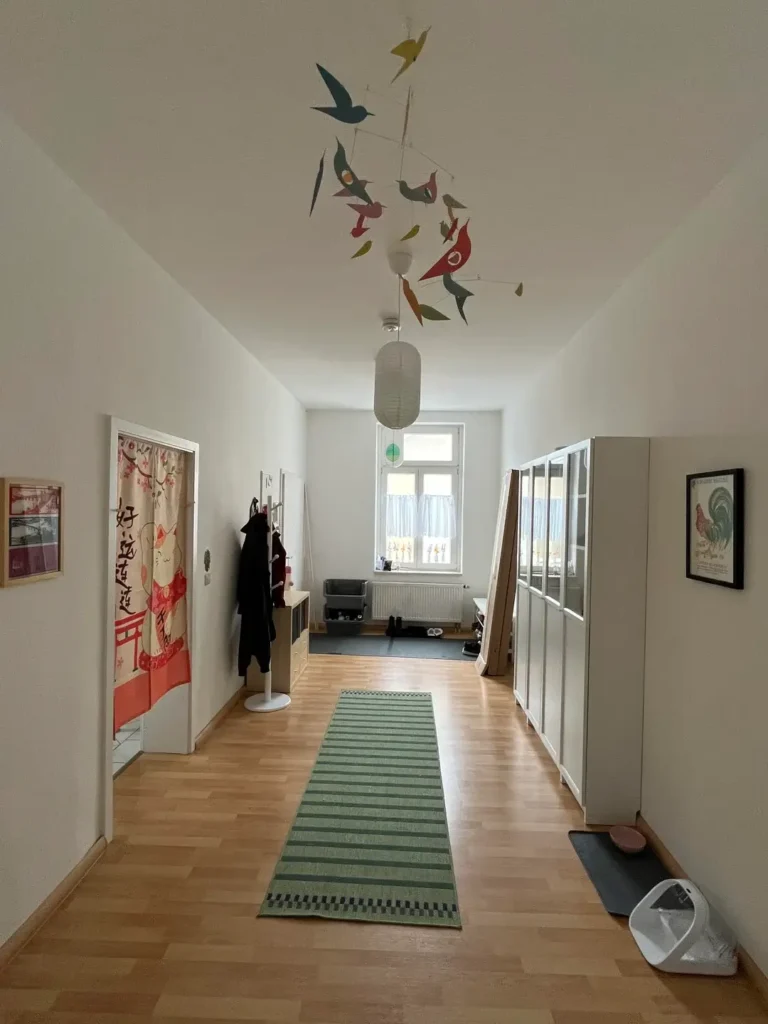
Not every hallway is narrow. When you’ve got width, the challenge shifts completely.
This homeowner transformed a wide European-style corridor with high ceilings into something that feels like a curated passageway between rooms. The standout detail is a large Calder-style bird mobile hanging from the ceiling, colorful paper or fabric birds in teal, red, gold, and dark green suspended from a wire frame. A cylindrical white paper lantern below it handles the actual lighting. On one wall, a Japanese noren curtain in soft reds and pinks hangs in a doorframe, working as both a room divider and a textile installation. A slim coat rack and low dresser handle functional storage. A sage green striped runner anchors the center of the floor.
Ceiling decor is criminally underused in hallways. People default to one overhead fixture and call it done. But in a high-ceilinged space, the ceiling plane is prime real estate. A mobile adds movement and personality that static art simply cannot match.
IMO, this is one of the most creative hallway ideas on the entire list. Cultural textiles, a noren curtain, a woven wall hanging, an embroidered panel, add warmth and texture that printed art alone just can’t replicate.
Two-Tone Walls + Gold Bench + Shag Runner = Sophisticated End-Wall Statement
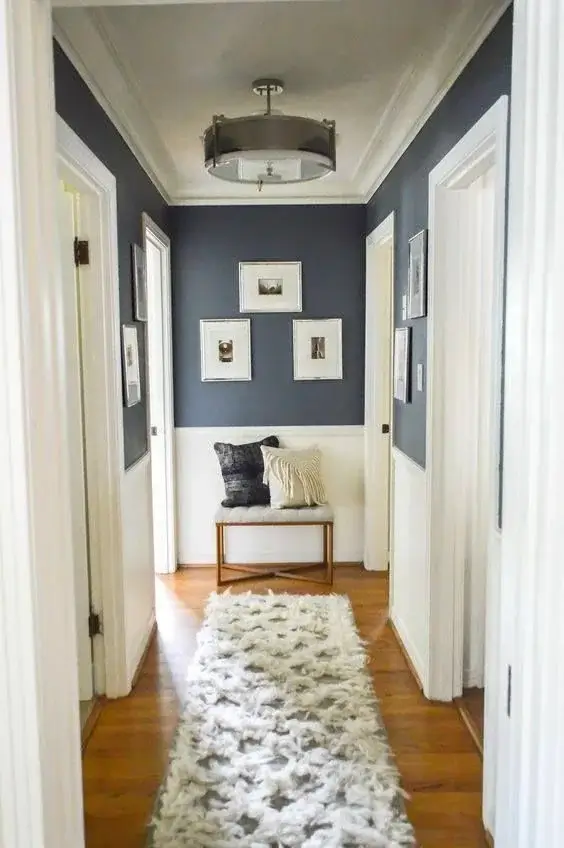
A hallway with a solid end wall isn’t a problem. It’s an opportunity. Treat it like one.
This homeowner painted the walls a deep slate blue with white wainscoting below a chair-rail line, creating a crisp two-tone division that visually widens the corridor. Three framed photographs in thin silver frames hang on the blue upper portion of the end wall, giving your eye a clear destination. A small gold-legged upholstered bench sits centered against that wall with charcoal and cream throw pillows. A thick off-white shag runner stretches down the hallway, contrasting beautifully with the warm wood floors beneath it.
Silver fixtures, silver frames, gold bench legs. Sounds like it should clash, right? The warm hardwood floor holds all those metals together. It’s the visual glue that keeps everything grounded.
If your hallway has a visible end wall:
- Hang something intentional at the terminus, a mirror, a small gallery, or a single large piece
- Place furniture below it. A bench signals arrival, the spot where you set things down before entering the rest of the house
- The two-tone wall treatment creates a horizontal line that makes the corridor feel wider than it actually is
Also Read: The Best School Hallway Ideas: 8 Real-Life Transformations to Try
Recessed Lights + Corner Shelf + Large Canvas Anchor an Upper Hallway
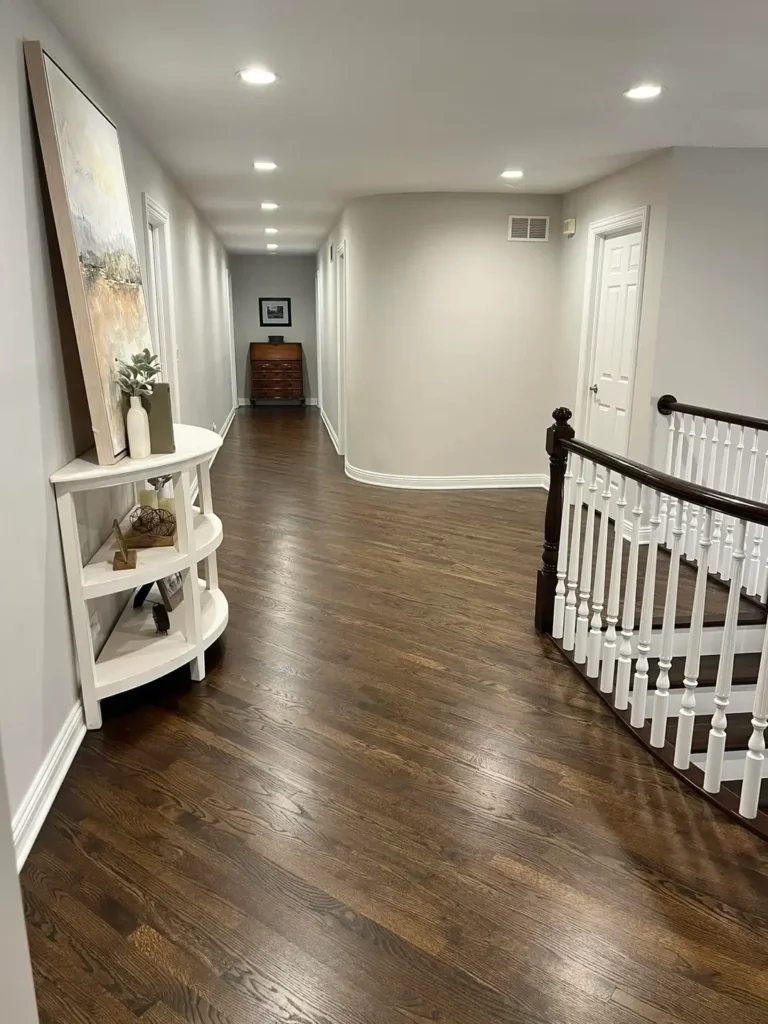
Upper hallways near staircases are their own unique beast. They’re wide, they have competing architectural elements, and they connect several rooms at once. Getting the balance right takes restraint.
This homeowner nailed it. Rich espresso-stained wide-plank oak floors steal the show immediately. Walls sit in a warm greige that shifts between almost-white and clearly-grey depending on the light. Recessed lighting runs the ceiling in evenly spaced rows. The only furniture is a white half-moon tiered shelf tucked near the stairs, styled with a small faux plant, a ceramic vase, a geometric metal sculpture, and a few stacked objects. A large abstract landscape canvas in warm ochre, grey, and ivory leans against the wall above it.
The restraint is exactly what makes this work. With wide-plank floors that gorgeous, piling on accessories would have buried the best feature in the room. The half-moon shelf is brilliant near a staircase because it doesn’t interrupt the sightline while still creating visual interest where the space opens up.
For open upper hallways:
- Choose furniture that works with the architecture, not against it. Half-round or corner-friendly pieces near stair openings keep traffic flowing naturally
- A large canvas leaning against the wall rather than hung feels relaxed and intentional, perfect energy for a transitional space
- Match your art scale to your wall scale. Go bigger than you think you need to
What Every Single One of These Hallways Has in Common
After looking at all ten examples, some clear patterns jump out that are worth flagging before you start spending money.
Runners are non-negotiable. Every single hallway on this list has one. The pattern, texture, and color of your runner sets the tone for everything else. It’s the one purchase that delivers the most visible return in a corridor.
Lighting transforms proportion. Whether it’s recessed cans, a sputnik chandelier, or a moody pendant with fringe, every successful example treats the ceiling fixture as a design element, not just a practical necessity. Upgrade your fixture before you do anything else.
The far wall needs a destination. In almost every image, something deliberate sits at the end of the hallway. Art, a mirror, a styled console. Your eye needs somewhere to land when it looks down a long corridor.
A few other patterns that keep showing up:
- Dark door paint transforms a hallway faster than any wall color change
- Mirrors create depth and bounce light in spaces that have neither
- Even one plant prevents a hallway from feeling sterile and lifeless
- Wainscoting adds architectural credibility to plain, flat walls instantly
- Consistent frame finishes unify a gallery wall even when the images are totally different
Quick Comparison: Long Hallway Decorating Ideas at a Glance
| Decorating Idea | Difficulty | Best For |
|---|---|---|
| Persian runner + sputnik fixture | Easy | Rental or owned homes |
| Black doors + diamond runner | Easy | High-contrast, modern spaces |
| Layered runners + console table | Easy | Very long narrow hallways |
| Vintage pendant + wall art gallery | Medium | High-ceiling traditional homes |
| Dark green walls + gallery | Medium | Statement-forward interiors |
| Wainscoting + walnut console + mirror | Medium-Hard | Wide, formal entryways |
| Gallery wall + recessed lighting | Medium | Long narrow corridors |
| Ceiling mobile + cultural textiles | Easy-Medium | Eclectic, wide hallways |
| Two-tone walls + bench + shag runner | Medium | Short hallways with end wall |
| Recessed lighting + corner shelf | Medium | Open upper hallways with stairs |
Your Hallway Deserves Better Than a Speed-Walk
Every homeowner on this list started in the exact same place. A long, awkward stretch of space that connected rooms but didn’t feel like anything. What separates their results isn’t budget or design school credentials. It’s simply the decision to treat the hallway as a space worth caring about.
You don’t need to tackle everything at once. Pick the one change that would make the biggest difference in your specific space, a runner, a statement light, a console table, or a coat of paint on the doors, and start there. Seriously, just start somewhere.
Long hallway decorating rewards decisive action over paralysis-by-perfection. Pick one thing you genuinely love, place it with intention, and let the rest of the space respond to it naturally. That’s exactly what every single homeowner on this list did.
So go ahead. Which idea are you stealing first?
