
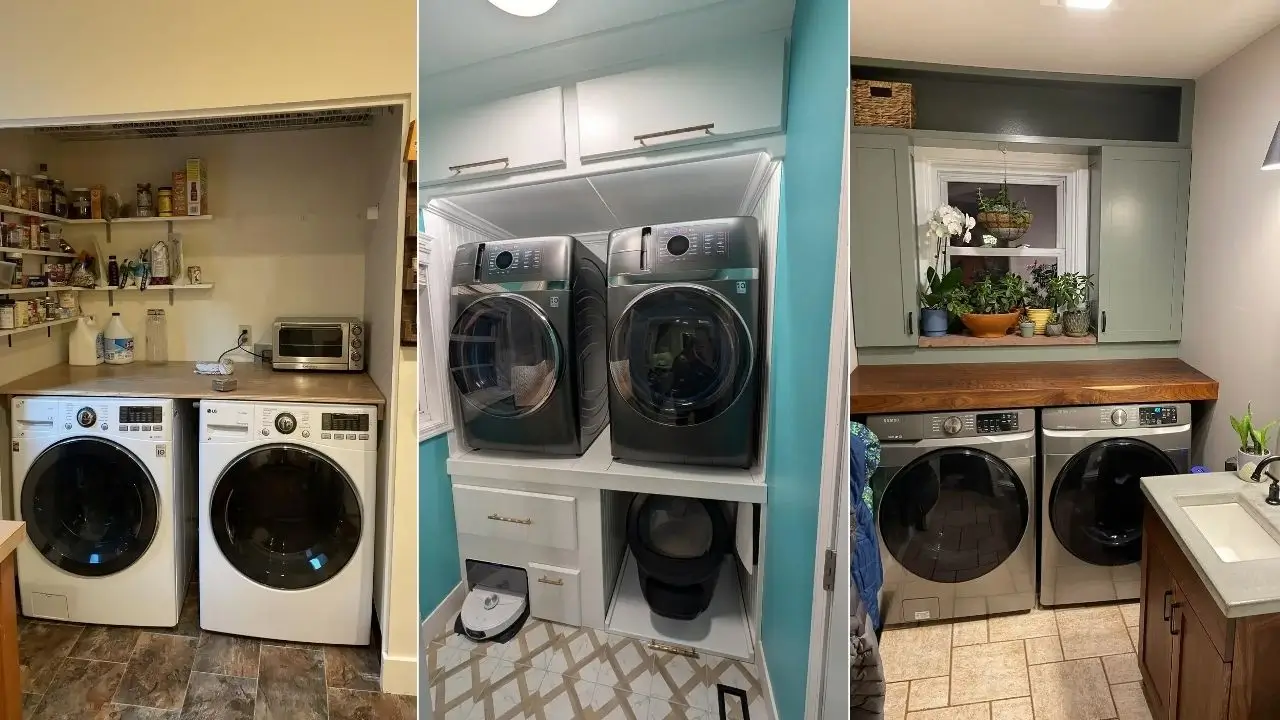
Let’s be honest. Your laundry room is probably the most neglected spot in your entire house. It’s where good intentions go to die, detergent bottles multiply at an alarming rate, and that one sock you lost six months ago is absolutely still hiding somewhere in the back corner. Sound familiar?
Here’s the thing though. It genuinely doesn’t have to stay that way.
I dug through a bunch of real laundry room setups shared by actual homeowners. No staged photos. No unlimited renovation budgets. Just regular people with regular machines trying to make a frustrating space actually function. And honestly? Some of what I found was really impressive.
So here are 15 laundry room organization ideas pulled straight from real homes. Some are budget-friendly hacks. Some are full glow-ups. A few are honest “here’s the problem and here’s exactly how to fix it” situations. All 15 have something worth stealing.
1. The Multi-Purpose Basement Laundry Room with Stone-Look Flooring
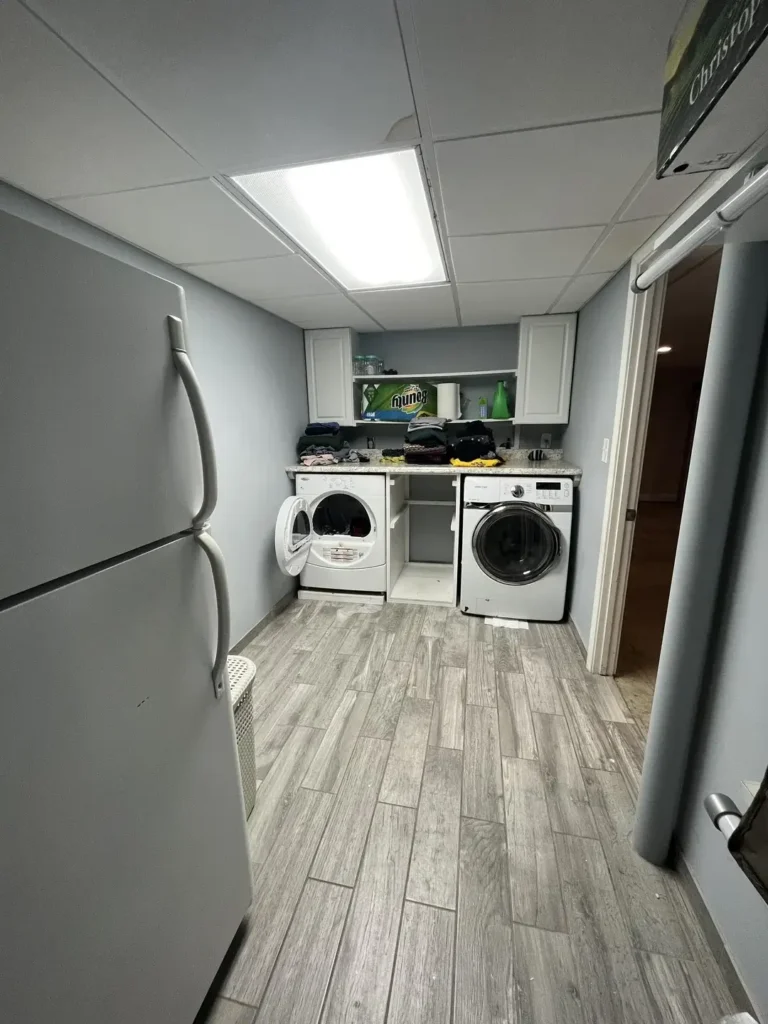
Basement laundry rooms have a reputation, and it’s not a flattering one. Exposed pipes, mystery smells, lighting that makes everyone look slightly unwell. You know the vibe. So when a basement laundry room actually looks put-together, it stops you in your tracks.
This wide basement setup features soft gray walls, a drop ceiling with flush panel lighting, and warm gray wood-look stone tile flooring. The machines sit side by side with a countertop running across them toward upper white cabinets and an open shelf in the middle. A full-size refrigerator on the left wall confirms this space pulls double duty as a utility room.
What makes it work is cohesion. The gray walls, gray tile, and white cabinets create a calm, coordinated palette that keeps the room from feeling like a storage unit. The countertop above the machines gives you an actual folding surface, and trust me, that single addition completely changes your laundry routine.
Quick tip: If you’re working with a basement setup, start with the floor. Stone-look tile costs way less than you’d expect and immediately makes the room look intentional. Add consistent cabinet colors and you’re already most of the way there.
2. Dark Wood Cabinets with Decorative Tile Backsplash and Walnut Countertop
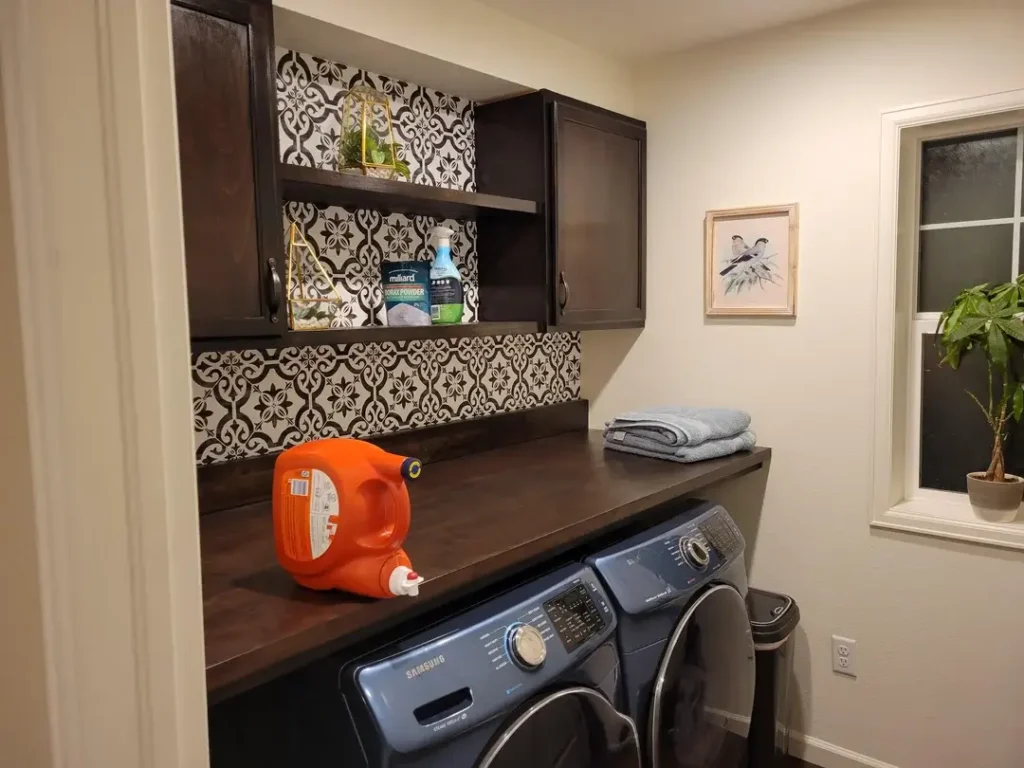
Most laundry rooms play it safe. White walls, white cabinets, white everything. Functional? Sure. Memorable? Absolutely not. This setup said “hard pass” and went full espresso-and-pattern, and honestly, it earned every bit of that confidence.
Rich espresso-stained wood cabinets pair with a bold black-and-white Moroccan-style patterned tile backsplash positioned between the upper cabinet and open shelf. The countertop above the front-loaders is a deep walnut-toned wood that ties directly into the cabinet color. A framed bird print and a small potted plant on the windowsill add just enough personality without overdoing it.
The backsplash tile is the real move here. Most people leave that gap between the shelf and upper cabinet completely blank. Filling it with pattern and texture turns dead wall space into the focal point of the entire room.
Want this look without gutting your walls? Peel-and-stick tile in a graphic pattern does the job for a fraction of the cost. It’s removable, affordable, and looks great when you pick the right pattern.
3. Laundry Closet with Bold Wallpaper, Wood Shelving, and Labeled Felt Bins
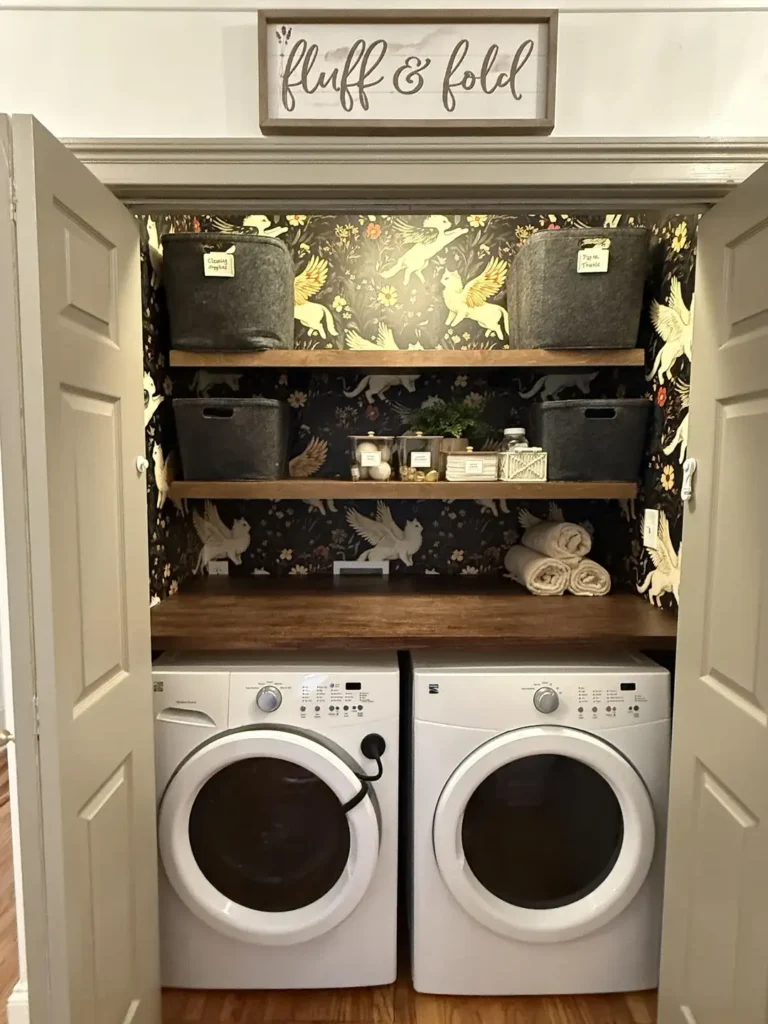
Converting a closet into a laundry nook is either genius or a headache depending entirely on what you do with those four walls. Get it wrong and you’re basically doing laundry inside a broom closet. Get it right and you get something like this.
This laundry closet features dark, moody wallpaper with cream-colored winged creatures and gold floral details on a near-black background. Warm wood floating shelves run wall-to-wall above white front-loaders, holding dark gray felt bins with handwritten labels, small decorative jars, and rolled linen towels. A “fluff and fold” wooden sign sits above the door frame, and yes, it absolutely works.
Here’s the counterintuitive truth about tight spaces: bold, dark wallpaper works better than light colors. Light colors just highlight how small the space is. Dark wallpaper creates atmosphere. Suddenly you’re not in a tiny closet. You’re in a small room with a deliberate personality.
FYI, those labeled bins are doing more work than they look like. One says “cleaning supplies.” Another says “dog towels.” You never have to think about where anything goes. That’s the whole system. A place for everything, clearly marked. Steal this idea immediately.
Also Read: Stop Treating Your Laundry Room Like a Junk Drawer: 15 Ideas to Steal
4. Budget Wall Shelves Maximizing Vertical Space for Bulk Storage
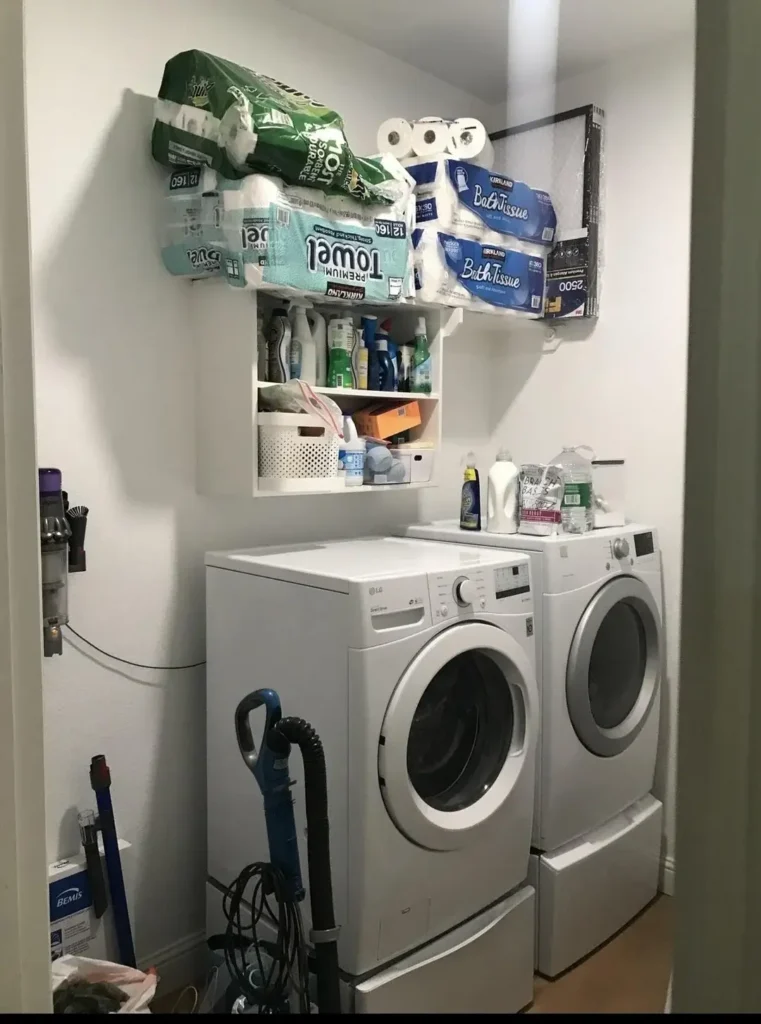
Not everyone wants to renovate. Some of us just want our Costco haul to stop living on the floor. Completely valid goal, and this setup actually delivers on it.
A small recessed wall niche sits alongside a wide floating shelf positioned high on the wall above front-loaders. The high shelf holds bulk paper towels, toilet paper, and oversized detergent. The recessed niche below stores cleaning supplies without any brackets sticking out into the room. A vacuum and hoses stay organized on the floor to one side.
Look, this isn’t ending up on any interior design blogs anytime soon. But it solves a real problem: where do you put giant bulk packs that don’t fit anywhere sensible? Up high on dedicated shelving, that’s where. The recessed niche is especially clever since it uses space between wall studs, so you gain storage depth without losing floor space.
A coat of paint on the shelves and a few matching bins would elevate this setup without a single weekend of real renovation work. Practical first, pretty later. That’s a completely legitimate approach.
5. A Functional but Cluttered Laundry Room That Needs a System
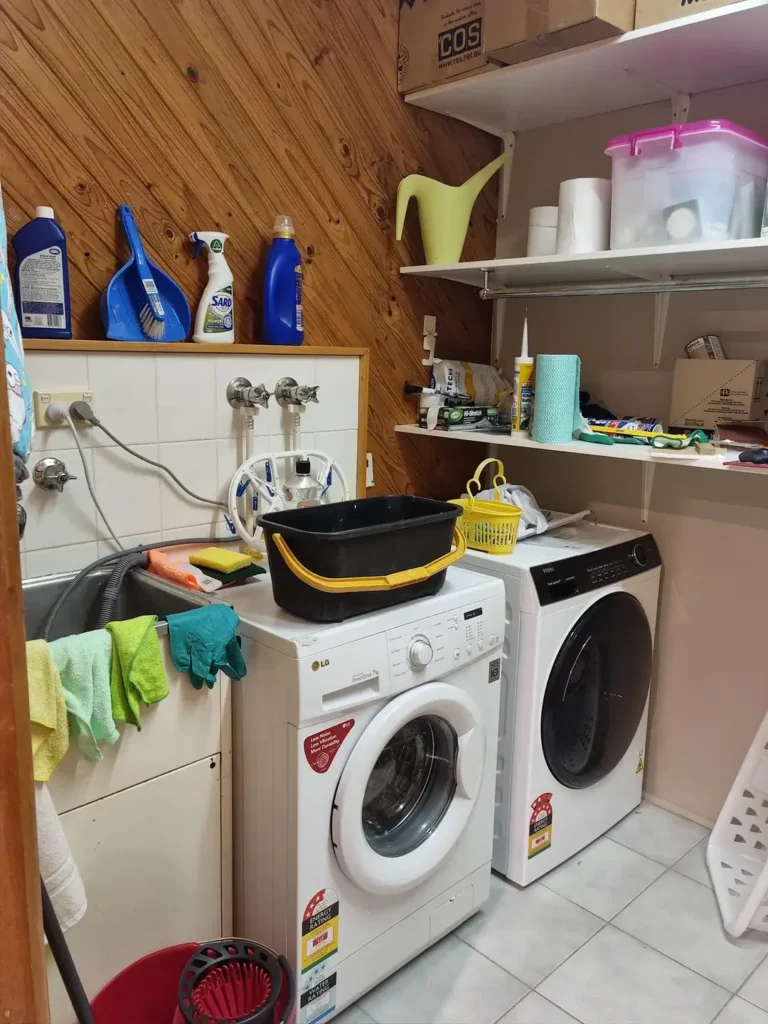
Sometimes the most useful thing you can see is a room that’s one good decision away from working really well. This is that room.
The setup has genuinely warm pine-plank walls, clean white ceramic tile floors, and two front-loaders side by side. Wall-mounted utility shelving holds a mix of plastic tubs, paper products, and cleaning bottles. A mop bucket sits near the machines. Supplies cover the sink cabinet with no real organizing logic holding them together.
The bones here are actually solid. Those pine walls are a feature, not a flaw. The tile floor is clean and durable. The problem is a pure systems failure. Items land wherever there’s room rather than where they belong, which means finding anything requires scanning every surface in the room.
The fix is genuinely simple. Introduce a consistent bin system on those shelves:
- One bin for laundry supplies
- One bin for cleaning tools
- One bin for paper goods
Label them. That’s the entire intervention. The pine walls stay, the character stays, and suddenly the room has a system instead of just surfaces.
6. Sage Green Cabinetry with Butcher Block Counter and Window Plant Shelf
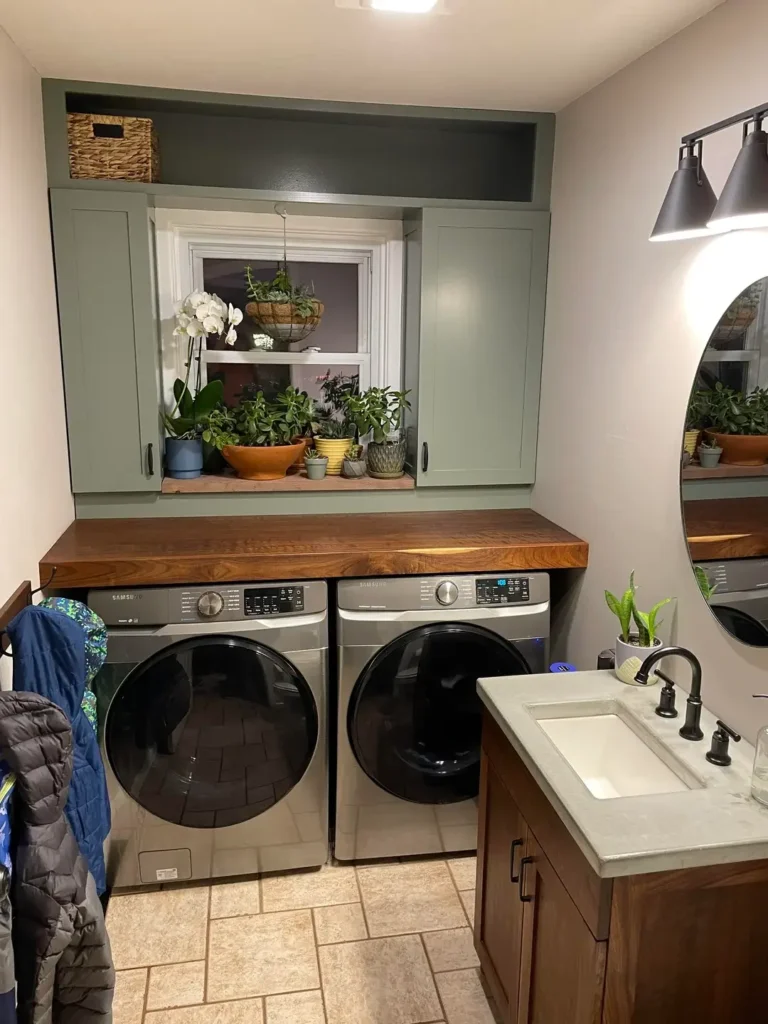
Every once in a while you come across a laundry room that makes you genuinely jealous. This is that laundry room.
Floor-to-ceiling sage green shaker-style cabinets, a thick butcher block countertop above two front-loaders, and a wide window ledge used as a plant shelf loaded with a white orchid, succulents, and trailing greenery in terracotta and sage pots. To the right sits an undermount sink in a wood vanity with a matte black faucet, topped by a round mirror and a matte black sconce.
The sage green ties everything together. The cabinets echo the plants, the plants echo the cabinets, and the whole room reads as one green-forward palette that feels calm and completely considered. The butcher block adds warmth so nothing tips into cold or clinical territory.
Here’s the detail most people miss: every hardware piece is matte black. Cabinet handles, faucet, light fixture, all matching and consistent. That’s what separates a room that looks “finished” from one that looks “okay.” You don’t need custom cabinets to pull this off. Paint existing cabinets and swap the hardware. Most of the impact, fraction of the cost.
Also Read: Small Laundry Room Makeovers: 15 Real-Life Stackable Setups
7. Top-Load Machines with Wire Shelving and Mixed Storage Containers
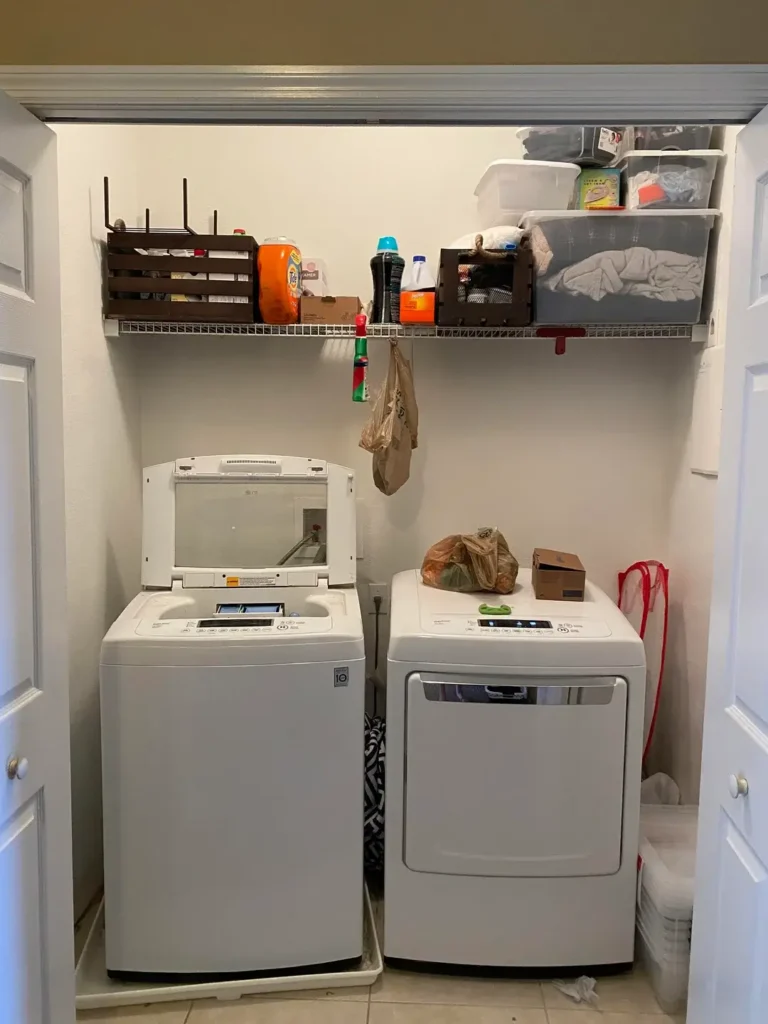
Wire shelving gets a bad rap, and honestly, it earns some of it. But in a practical laundry setup it does its job fine, and the key word is “fine” and only when you use it thoughtfully.
A closet-style laundry space with white top-load machines features a single wire shelf running wall-to-wall above them. The shelf holds a mix of dark wood crates, plastic storage bins, folded textiles, and detergent bottles. A few reusable bags hang off the shelf edge.
The shelf is doing its job. Supplies are off the machine tops and within reach. The issue? Container chaos. Dark wood crates, gray plastic bins, and clear totes living together read as “I grabbed whatever was on sale” rather than “I have a system.” The storage categories are right. The visual consistency isn’t there yet.
The one-move fix: replace the mixed containers with three or four matching baskets and label each one by category. That single change, visual consistency in your containers, delivers more perceived organization than almost anything else you can do in this space.
8. Full Built-In Shelving Wall with Hanging Bar, Sink, and Sage Blue Walls
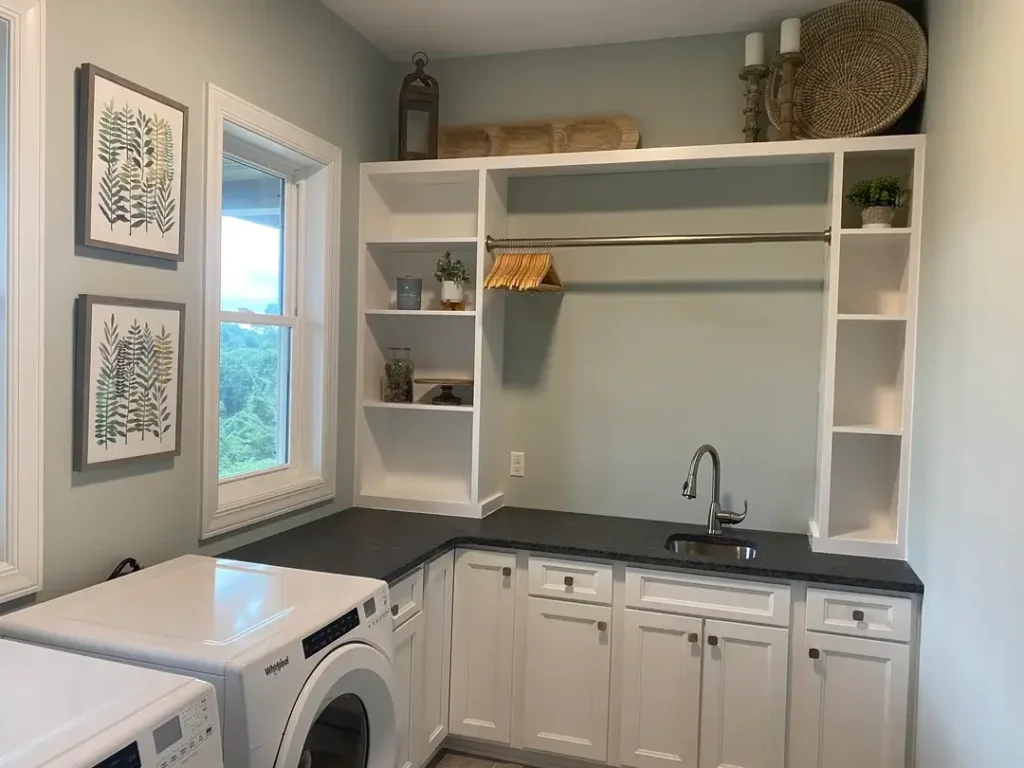
A hanging bar in the laundry room sounds like a minor upgrade until you’ve spent years draping wet shirts over doorknobs and wondering why they still smell slightly off. IMO, it’s one of the most underrated features a laundry room can have.
This setup features a full wall of white built-in shelving in a soft sage blue room. It includes upper cabinets, side vertical cubbies, a center hanging rail loaded with wooden hangers, and a lower countertop with an integrated utility sink. Botanical prints hang on the adjacent wall beside a large window. Decorative items like a woven tray, candles, and a lantern run across the top of the whole unit.
The hanging bar changes the entire daily routine. Pull out anything that can’t go in the dryer, hang it immediately, and it stays wrinkle-free without occupying a bedroom chair for three days.
If you’re planning built-ins, don’t treat the hanging bar as an afterthought. Design a dedicated zone for it from the start. A bar that’s clearly incorporated
9. Closet Conversion with Shiplap Walls, Recessed Built-Ins, and Woven Baskets
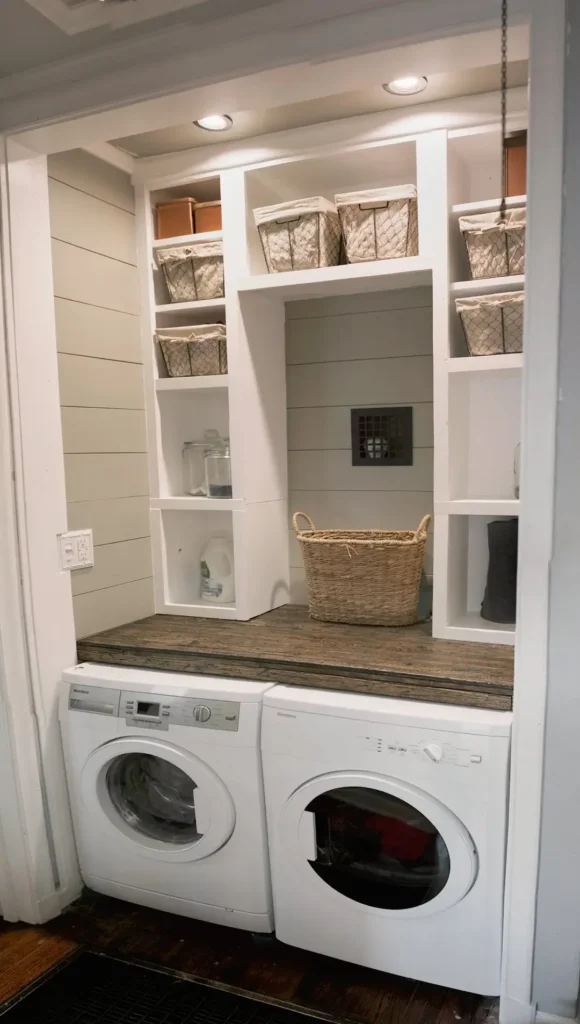
Closet-to-laundry conversions are tricky. Do them right and you’ve created something impressive. Do them wrong and you’ve just put a washing machine in a closet. This one absolutely nailed it.
A finished laundry niche features white shiplap paneling on the back wall, recessed can lighting overhead, and a full surround of white built-in cubbies. Woven wire-and-linen baskets fill the upper shelves. A large seagrass basket sits on a rustic barnwood countertop bridging the two front-loaders below. A glass jar of detergent pods lives on the lower shelf, a small detail that makes the whole thing feel cohesive.
The shiplap back wall adds texture without adding color. It keeps things visually interesting while the all-white palette stays calm. Recessed lighting is a must in any niche conversion since overhead fixtures eat into headroom and look awkward. Recessed cans keep the ceiling clean and the space feeling open.
Here’s the pro tip from this setup: decide on your basket size before you finalize the carpentry. The cubbies look custom-fitted because they are. The builder measured the baskets first and built around them. That result looks expensive. The secret is just planning in the right order.
Also Read: 10 Blue Laundry Room Ideas That Prove Laundry Day Can Actually Look Good
10. Full Cabinet Overhaul with Butcher Block Counter, Hanging Rod, and Patterned Tile Floor
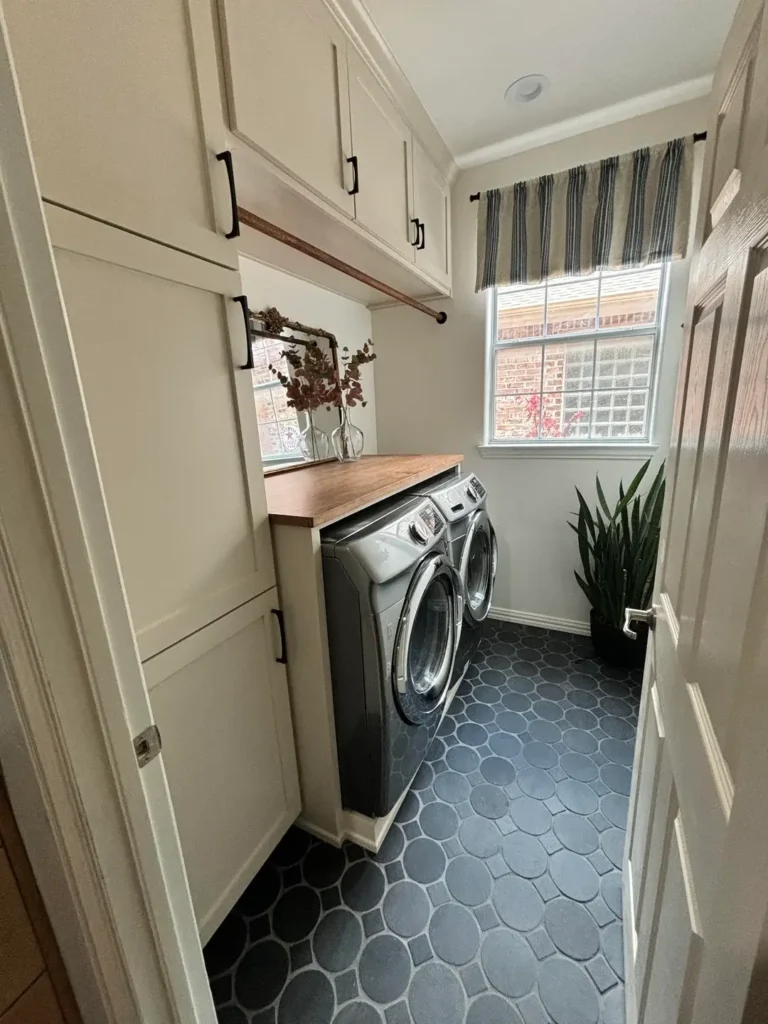
White cabinets plus butcher block plus a hanging rod. You’ve seen that combination before. What makes this version stand out is the floor, and once you see it, you really can’t unsee it.
This laundry room overhaul features full-height white shaker cabinets, a warm butcher block countertop over the front-loaders, an iron pipe hanging rod below the upper cabinets, and a charcoal pebble-and-diamond mosaic tile floor that stops you mid-scroll. A striped window valance, snake plant, and dried eucalyptus in a glass vase add life without adding clutter.
That floor is doing serious heavy lifting. The dark charcoal mosaic contrasts cleanly against white cabinetry and makes the room feel grounded and considered. Light floors would have made this look fine. The dark floor makes it look designed. Big difference.
The hanging rod on iron pipe brackets below the upper cabinets is a weekend project that costs almost nothing and immediately improves daily function. If you have a gap between your upper cabinets and countertop, that’s your dedicated hang-dry zone waiting to happen.
11. Functional Oak Cabinet Laundry Room That Just Needs a Plan
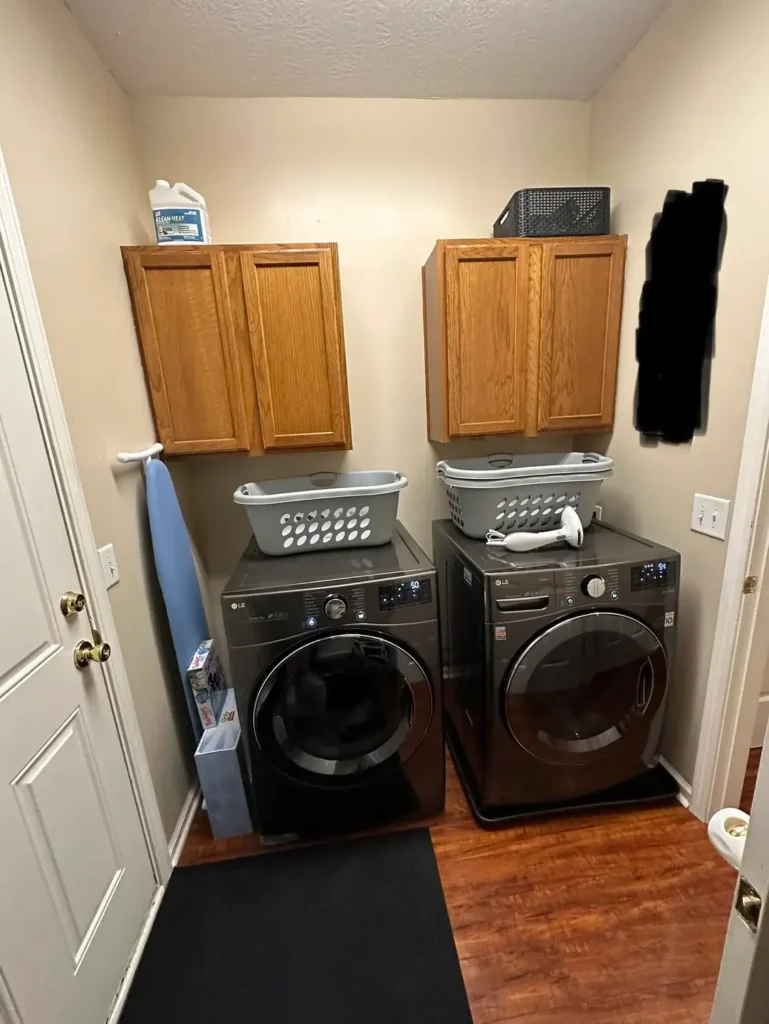
This one is for everyone who has all the right pieces but something still feels off. The machines are great, the cabinets work, the space is fine, but it still feels chaotic. Here’s exactly why, and exactly how to fix it.
The room features warm honey oak upper cabinets above two large dark charcoal front-loaders. Gray laundry baskets sit on each machine, a hair dryer rests on the dryer top, a storage tray sits on the upper cabinets, and an ironing board leans against the left wall. Everything is functional. Nothing has a specific assigned home.
The ironing board leaning against the wall is the tell. It’s there because there’s nowhere else to put it, not because someone decided that was its spot. The hair dryer on the dryer, the baskets on the machine tops, same story. This room isn’t disorganized. It just lacks assigned places for things.
Here’s the three-move fix:
- Dedicate one upper cabinet to the small items currently living on top of the machines
- Add an over-the-door ironing board mount, they’re affordable and genuinely work
- Paint those oak cabinets, a fresh color makes the single biggest visual difference this room can get
12. DIY Green Cube Shelving with Butcher Block Counter and Farmhouse Sign
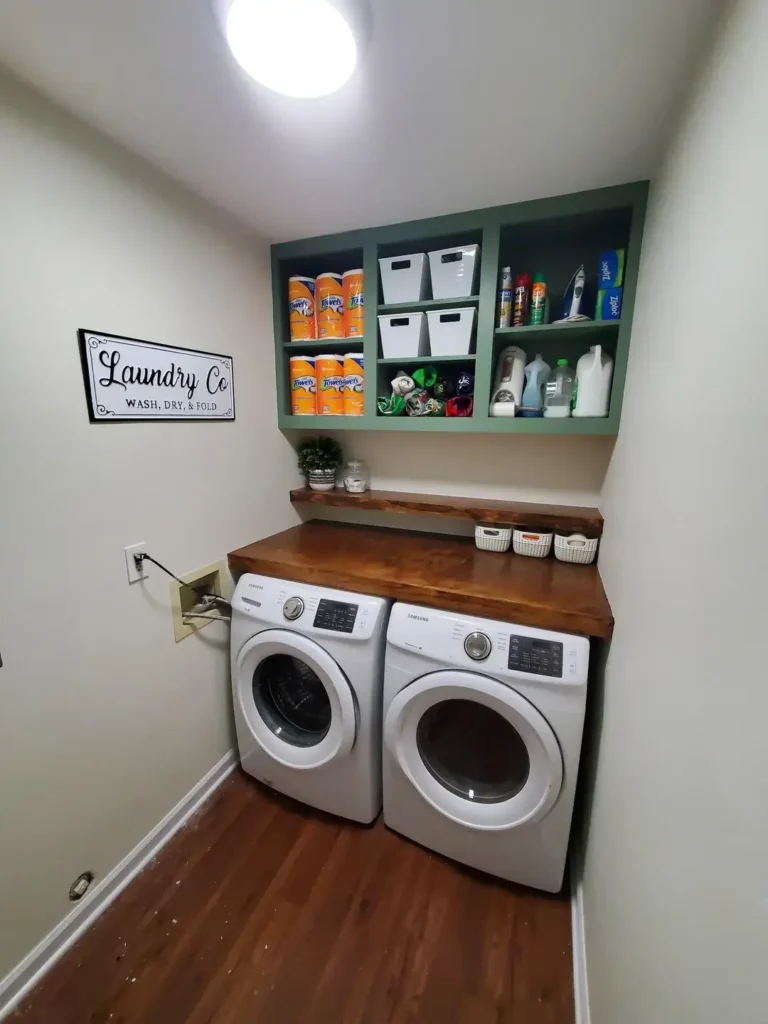
Bold color in a laundry room is a commitment. Most people talk themselves out of it. This person didn’t, and the room is considerably better for it.
A deep forest green cube shelving unit mounts above the washer and dryer zone, with a thick butcher block countertop across the white front-loaders below. The green cubbies hold paper towel rolls, white storage bins, cleaning supplies, and a small plant. A “Laundry Co. Wash, Dry and Fold” sign hangs on the left wall. Small white woven baskets line the countertop edge.
The forest green works because it’s fully committed. A timid sage against cream walls would have looked washed out. This deep green reads as confident and specific. It’s clearly a choice, not an accident. The walnut butcher block bridges the green shelving and white machines with warmth, and the whole thing becomes the kind of laundry room people actually photograph and save.
One detail worth stealing: white bins inside the green cubbies. High-contrast containers inside bold-colored shelving keep the visual structure readable at a glance. If you’re building or painting cube shelving, choose your bin color before your shelf color. That contrast relationship is what makes the finished product look intentional.
13. Kitchen-Adjacent Laundry Niche Doing Double Duty as Pantry Storage
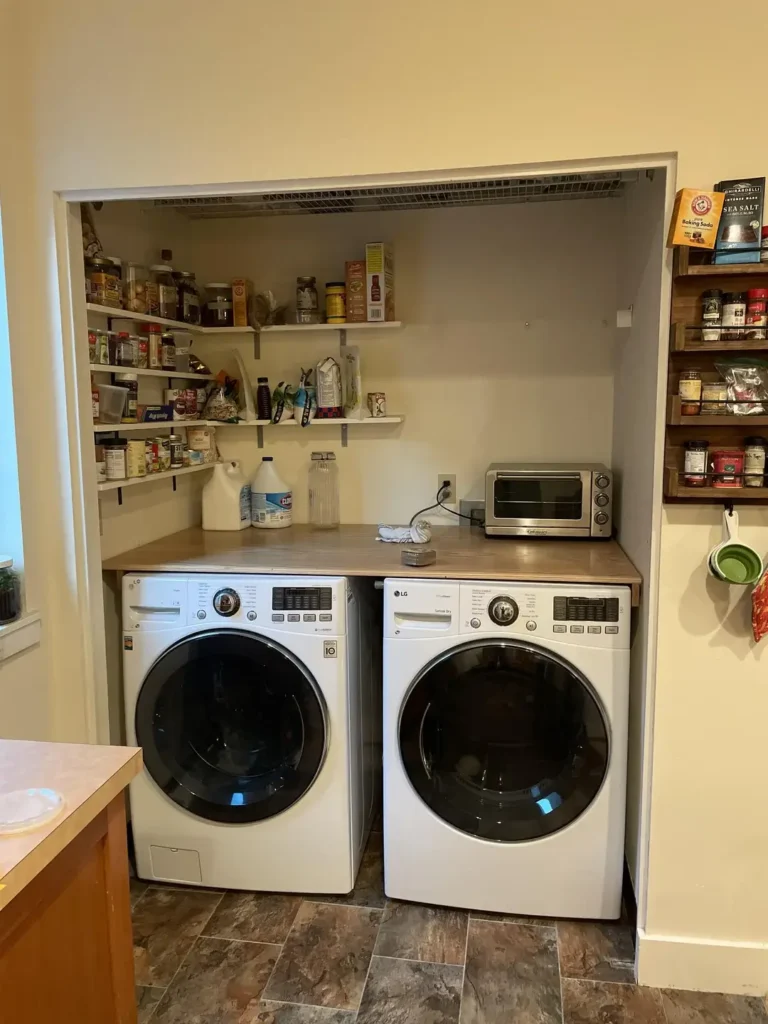
Some homes don’t have the luxury of clearly separated storage zones for everything. So they get creative. This setup pushed that creativity pretty far and it mostly works, with one honest caveat.
An open laundry niche features white front-loaders below a light wood countertop, with shelves above holding a dense mix of pantry goods including spice jars, baking supplies, cleaning products, and a toaster oven sharing the folding surface. A wall-mounted spice rack to the right of the niche adds even more storage capacity.
This is a smart response to a real storage problem. The laundry niche effectively becomes an overflow pantry and handles a lot of household items in a compact footprint. The challenge is that cleaning products and baking supplies sitting next to each other create low-level mental friction. Your brain has to work slightly harder to figure out what belongs where every single time you scan those shelves.
The fix doesn’t require new shelving at all. Split the zone visually by dedicating the left section to laundry and cleaning supplies and the right section to food and kitchen goods. Add matching bins within each section and suddenly the mixed use feels deliberate rather than crowded.
14. Rope Basket and Wire Bin Floating Shelves Above Top-Loaders
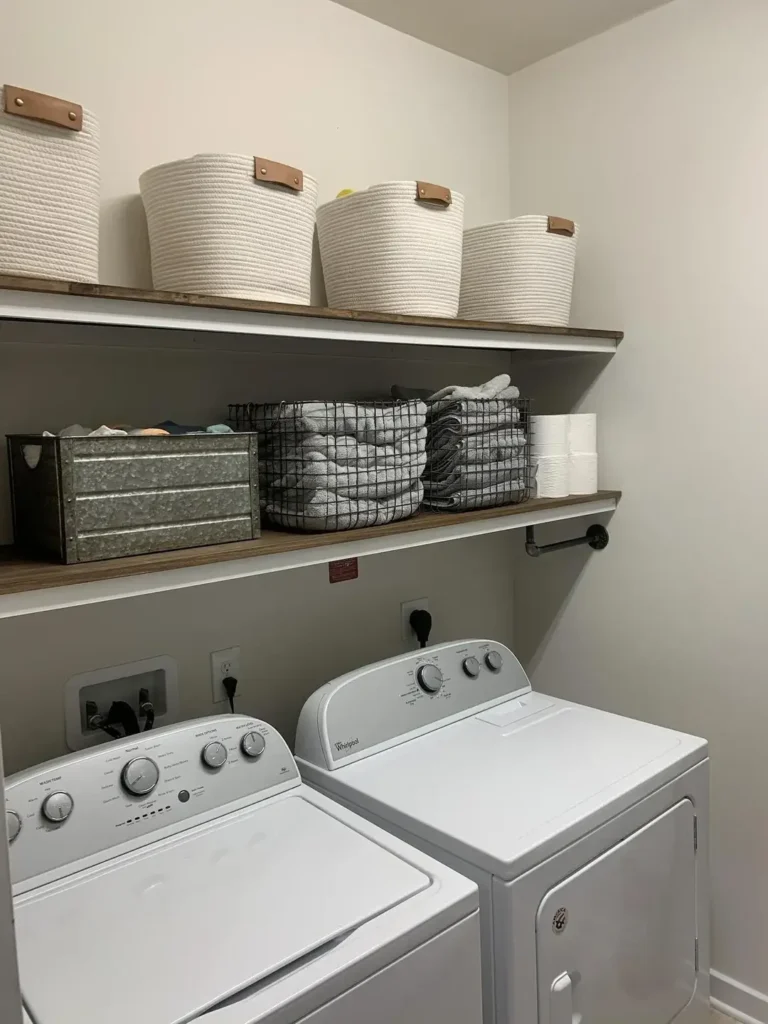
Your storage containers aren’t just containers. They set the entire tone of the room. Pick random ones and your shelves look like a garage sale. Pick with intention and they become part of the design. This setup understands that completely.
Two floating wood shelves sit above white top-loaders, both with a matching warm wood edge. The upper shelf holds three large white rope baskets with tan leather handles. The lower shelf holds rectangular galvanized metal bins and wire-frame baskets with folded gray towels, plus a small black pipe bracket mount that adds a subtle industrial touch.
Three different materials, rope, galvanized metal, and wire, and it doesn’t feel scattered at all. Why? Color discipline. Everything is white, cream, gray, or metal. The textures vary. The palette doesn’t. The leather handles on the rope baskets are a small detail that signals the whole thing was thought through rather than improvised.
For top-loaders where a countertop isn’t possible, the dual-shelf system with size logic is your best setup:
- Upper shelf: larger baskets for bulky or less-frequently accessed items
- Lower shelf: smaller bins for daily-reach supplies
Plan that logic before you install anything. It’s the difference between shelving that works and shelving that just holds stuff.
15. Raised Machines on Custom Pedestal with Built-In Storage and Teal Walls
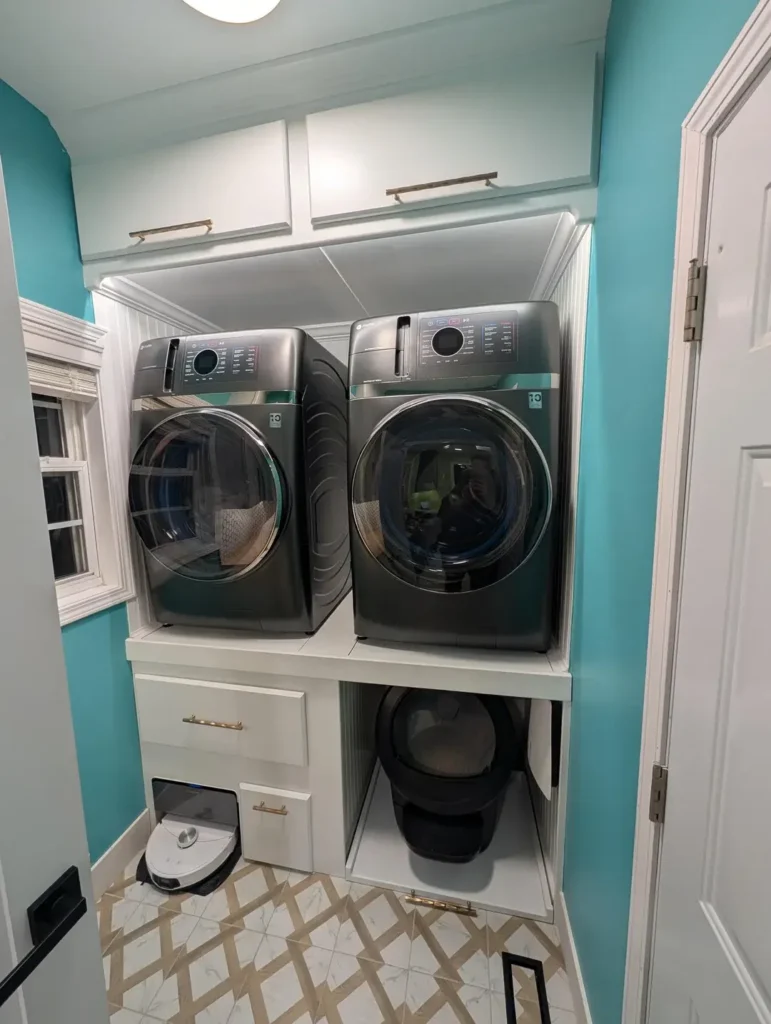
Raising your washing machine off the floor might sound like a luxury renovation move. It’s really not. And once you understand what it actually solves, you’ll wonder why you waited this long.
A custom white wood pedestal raises two large stainless front-loaders to a comfortable hip height. The pedestal includes a drawer on the left and an open cubby on the right housing a robot vacuum and a round hamper. Above the machines sit two wide white cabinets with gold bar pulls. The walls are a vivid teal blue. The floor features white-and-gold geometric tile. This room does not do subtle, and it earns every bit of that energy.
The teal walls grab you first, and they earn that attention. They work because everything else is white, the cabinetry, the pedestal, the ceiling. Teal as the single bold element reads as intentional rather than overwhelming. The gold hardware ties to the floor tile, creating a warm metallic thread running through the entire room.
But the pedestal is the real MVP here. Loading and unloading front-loaders at floor height is genuinely hard on your back over time. Raising them to hip height eliminates that strain permanently. The built-in storage below turns dead platform space into functional drawers and cubbies. If you’re doing any laundry room work at all, a raised pedestal is worth every single penny.
Quick Comparison: Which Storage Approach Fits Your Space?
| Storage Approach | Best For | Difficulty Level | Relative Cost |
|---|---|---|---|
| Wire shelf with bins | Closet-style laundry nooks | Easy | Low |
| Floating wood shelves | Top-loader rooms with open wall | Easy to Medium | Low to Medium |
| Countertop over front-loaders | Any front-load setup | Medium | Medium |
| Full built-in cabinetry | Dedicated laundry rooms | Advanced | High |
| Raised machine pedestal | Front-loaders, any room size | Medium to Advanced | Medium to High |
| Open cube shelving unit | Small-to-medium rooms with blank wall | Easy to Medium | Low to Medium |
What Every Great Laundry Room Actually Has in Commonat Laundry Room Actually Has in Common
After going through all 15 of these setups, a few things keep showing up no matter the budget, style, or room size. These are the non-negotiables, the things that separate a room that genuinely works from one that just exists.
Everything has an assigned home. The best rooms don’t just have storage. They have specific storage for specific things. Labeled bins, dedicated cubbies, designated shelf zones. You should never have to think about where your detergent lives. If you do, the system isn’t finished yet.
There’s always a folding surface. A countertop bridging the machines changes the entire experience of doing laundry. Folded clothes have a landing spot that isn’t the dryer lid or the floor. The machines stop looking like two random appliances and start looking like part of an intentional layout. This is the single highest-impact upgrade most laundry rooms can make, and it doesn’t have to be expensive.
One aesthetic direction, fully committed. The rooms that feel unfinished share a common problem: a little bit of everything. Some wood, some wire, some plastic, colors that almost coordinate but not quite. The rooms that feel done made one choice, one material family, one color palette, and stuck with it. That decision costs nothing. It just requires making it before you start shopping, not after.
Give Your Laundry Room the Attention It Deserves
Will an organized laundry room make you love doing laundry? Let’s be real, probably not. But it will make you hate it noticeably less. It’ll stop quietly draining a little bit of your energy every single time you walk past it. That’s a real, tangible return on a pretty small investment.
Pick one idea from this list. Just one. Start there, see how it feels, and build from it. You don’t need to renovate everything at once. You just need to start making intentional choices instead of default ones.
Give it a shot. Your future self, the one who can find the stain remover in under 10 seconds, will absolutely thank you.
