
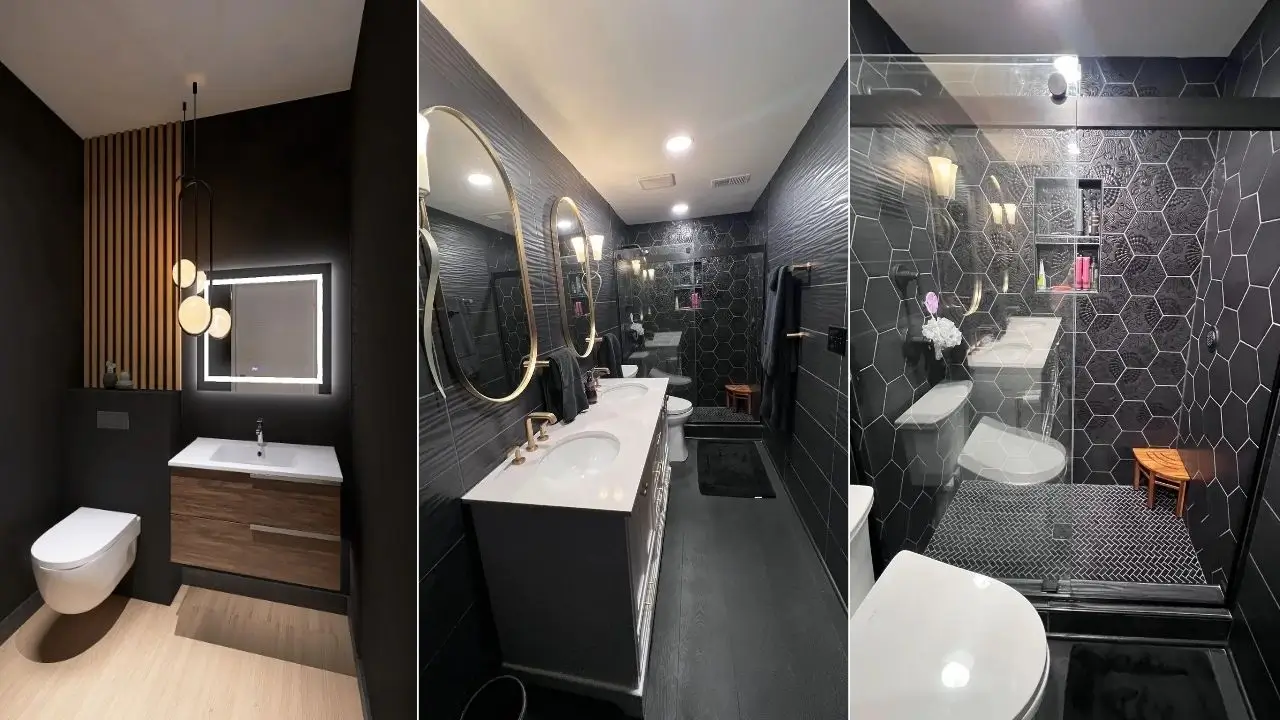
Let’s be honest — most of us have been scared straight by decades of “keep small spaces light and airy” advice. Black walls in a bathroom? Sounds like a cry for help, right?
Wrong.
I’ve been looking at 12 real bathrooms — not staged hotel shoots, not Pinterest fantasies — where actual homeowners went dark and came out winning. Some are polished. Some are still works in progress. One has a color combo that makes zero sense on paper but somehow slaps in real life.
Here’s what they all got right, and what you can steal for your own space.
Matte Black Walls with Warm Wood Slats and Pendant Lighting
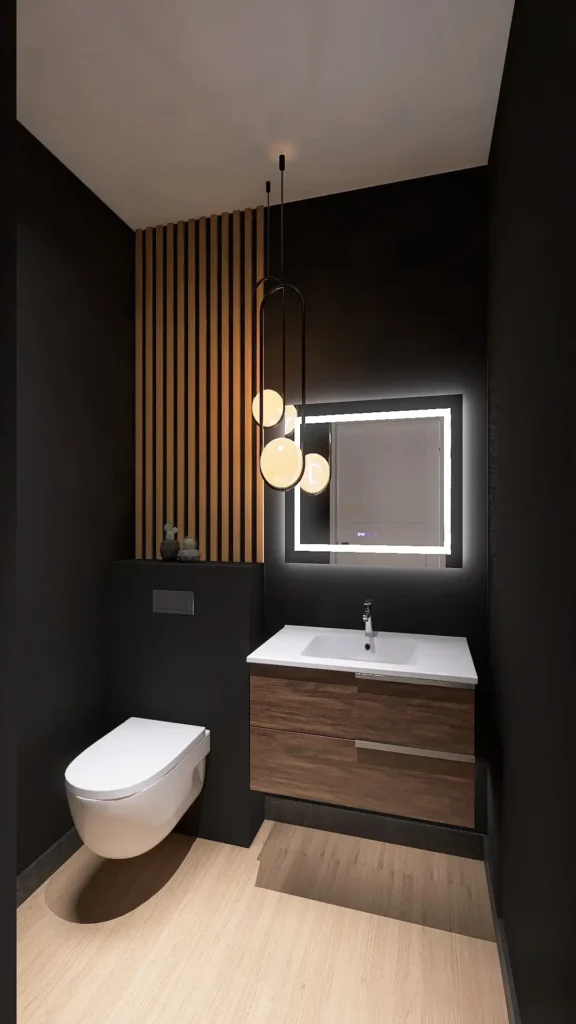
Black bathrooms get a bad reputation for feeling cold and cave-like. This one doesn’t.
The secret? Contrast done right. Matte black walls paired with a vertical honey-toned oak slat panel behind the toilet create a warmth that most people completely miss when they picture a dark bathroom.
The lighting does the rest of the heavy lifting:
- Three amber glass globe pendant lights give off a soft, candlelit vibe
- A backlit LED mirror handles the functional stuff without killing the mood
- Both light sources exist at different color temperatures and somehow coexist peacefully
The floating walnut vanity with an undermount white sink keeps that warm wood theme going. And the floor? Light oak-look planks — a smart break from the dark palette that stops the whole room from feeling like a black hole.
The biggest takeaway here: Sort your lighting before you even touch a paint swatch. Warm-toned bulbs and amber glass change how black reads on a wall. A cold LED strip against matte black paint hits very differently than amber globe pendants. Trust me on this one.
Full Commitment: Black Subway Tile, Black Toilet, and Dark Everything
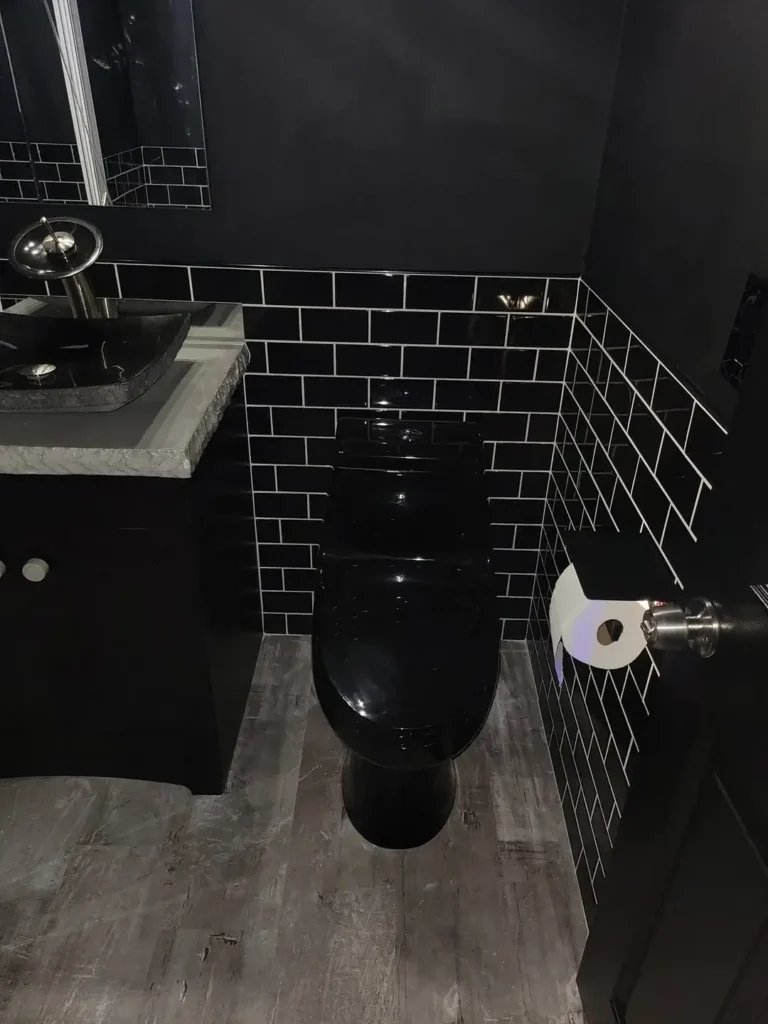
Some people slap one dark accent wall on and call themselves brave. This homeowner ripped everything out and replaced it with an all-black-on-black bathroom. We’re talking glossy subway tile halfway up, matte black paint above, black toilet, black vessel sink, and charcoal grey LVP flooring.
And it works. Here’s why.
The mix of finishes is doing a lot of secret work. Glossy tiles catch light in a way the matte paint above them doesn’t. That difference in texture creates visual separation between the two zones without needing a second color. The white grout lines are the only real contrast, and they give just enough definition to stop the tile from disappearing into itself.
The chrome and silver fixtures are also a smart call. Brushed nickel against all-black creates contrast without warmth, which fits the industrial edge this space is clearly going for.
One practical note if you’re tempted to copy this: black toilets are a commitment. The selection is narrower and they cost more. If budget is a concern, keep the toilet white and focus the black on tiles and walls. Honestly? Nobody will
Dark Moody Cloakroom with Encaustic Floor Tiles and Brass Pendant Lights
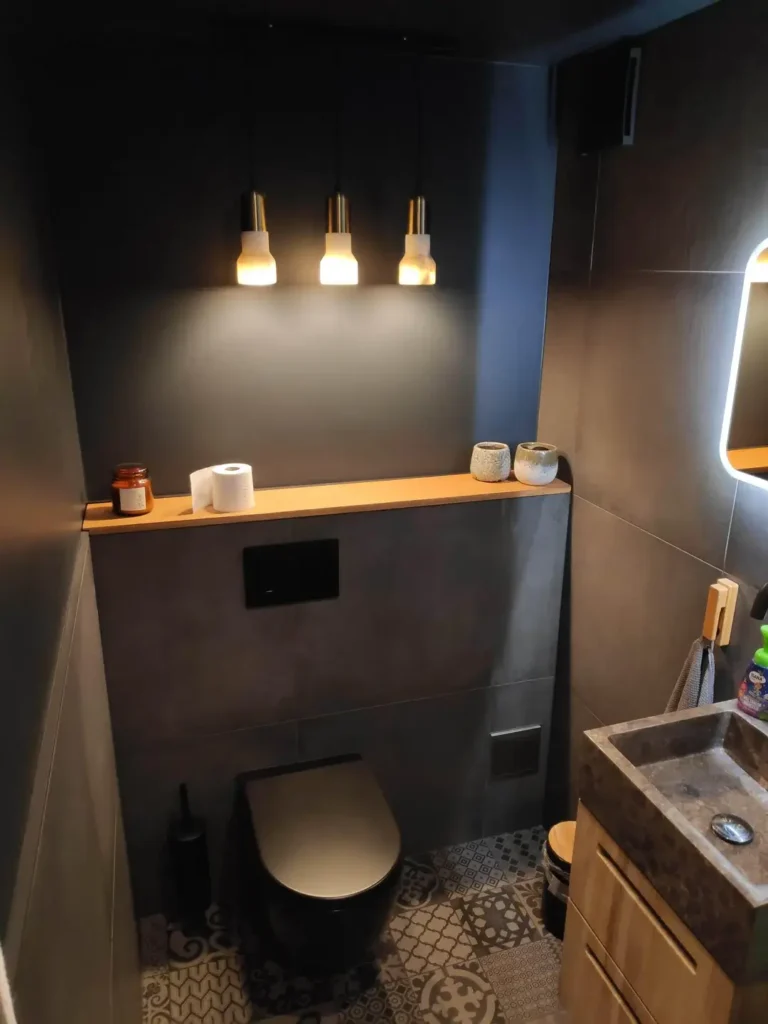
This tiny cloakroom manages to feel like somewhere you’d actually want to hang out, which is a sentence I never thought I’d write about a bathroom.
Dark grey microcement-effect walls, a geometric encaustic patterned floor, and three matching brass pendant lights with alabaster-style shades create something that feels deliberate rather than just small. A built-in half-wall above the concealed cistern doubles as a functional ledge, topped with a warm wood shelf holding candles, a toilet roll, and a few small ceramic pieces.
That shelf is working harder than it looks. It’s a warm horizontal break that stops the grey walls from feeling relentless.
The three pendant lights hang in a line above the shelf, casting warm light that shows off the texture of the microcement walls. A lighted mirror in the corner handles the functional side without ruining the vibe.
Floor choice in a dark bathroom matters more than people realize. An encaustic geometric pattern adds visual interest right where your eye naturally rests — and it softens the seriousness of the dark walls without fighting them.
Also Read: Black Bathroom Ideas? 12 Ways to Turn It Into a Quiet Escape (No Art Degree Required)
All-Black Remodel with Textured Wave Tile and Brass Gold Fixtures
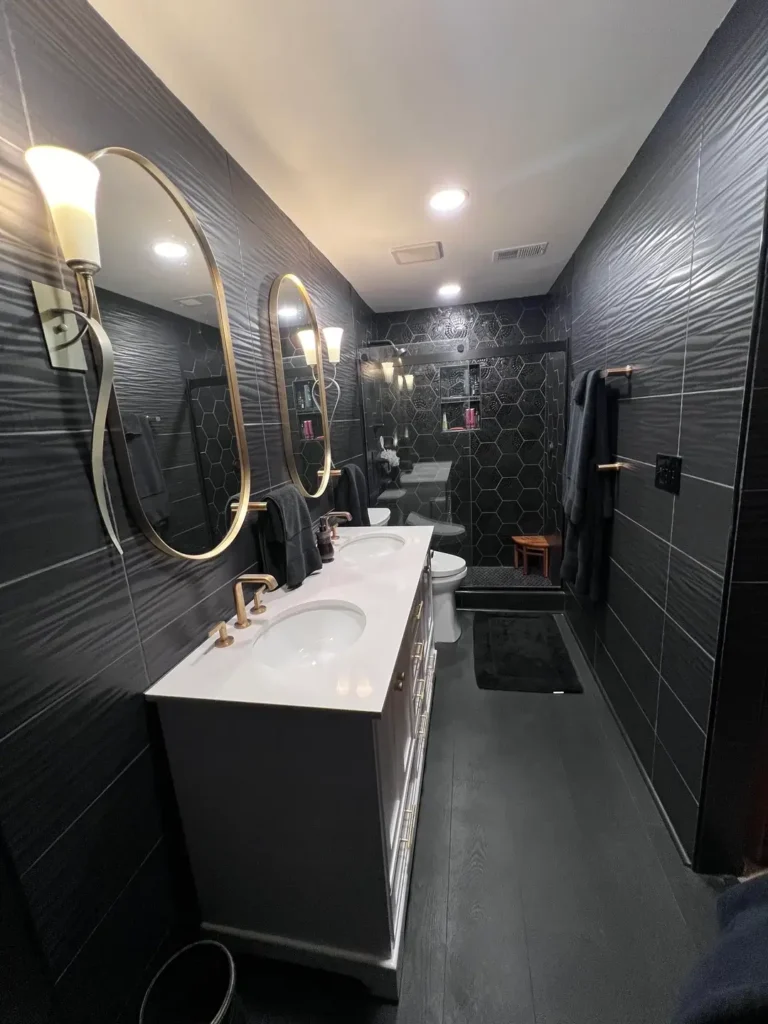
What happens when you tile every single surface in a full bathroom with black textured tile and add brass fixtures throughout? You get something that looks like a high-end hotel spa somehow ended up in a residential house. IMO, that’s not a bad problem to have.
The textured wave-pattern wall tiles, embossed hexagonal shower tiles, and black floor create a layered, tonal environment where the interest comes from surface variation rather than color contrast. It’s all black, but it never gets boring.
The white double vanity and white ceiling are absolutely essential here. Without those light surfaces, this room would cross from moody into suffocating. Those white elements give your eyes somewhere to land and breathe.
The double round brass mirrors are the right call too. Square mirrors would have felt too rigid against all those organic tile textures. The circular shape adds softness, and the gold tone warms up a space that could otherwise feel cold despite all its ambition.
Full floor-to-ceiling tile comes with a serious price tag. If you want this look without the full investment, tile just the shower surround in textured black and keep the main walls painted. The shower becomes the statement feature. The rest supports it.
Dark Walls with Ornate Gold Mirror and Gallery-Style Art
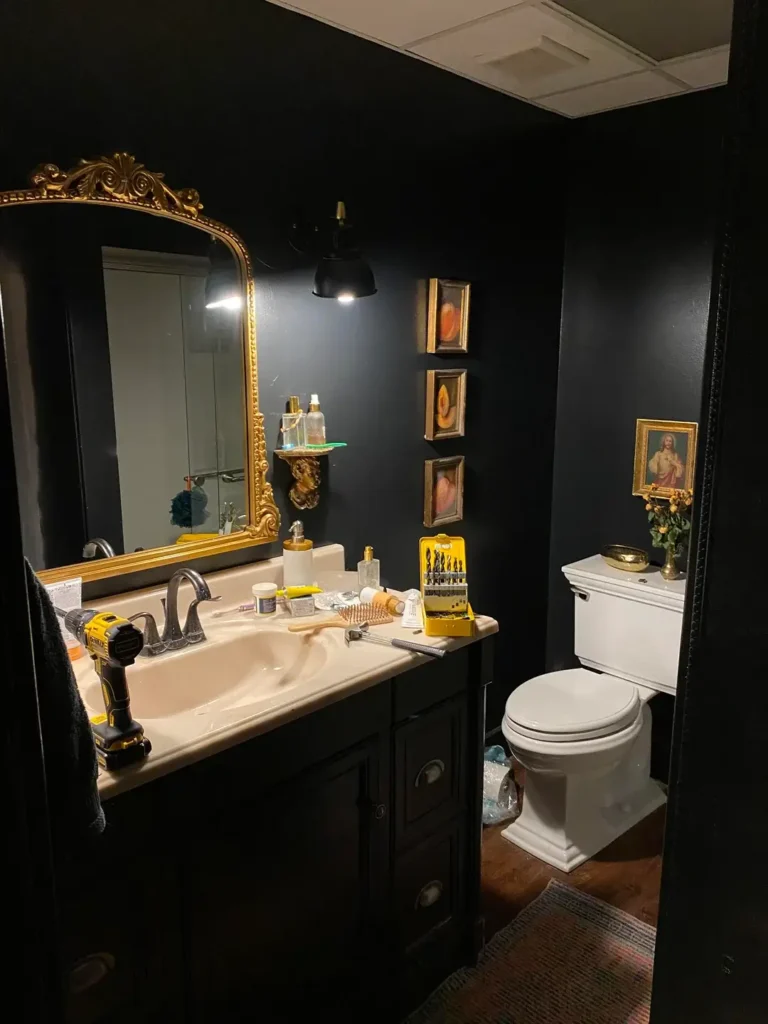
Fair warning: this one was mid-renovation when the photo was taken. There’s a drill on the counter. Supplies everywhere. But the bones of what’s being built here are absolutely worth examining.
Deep navy-black walls paired with an ornate, heavily carved gold-framed mirror create a contrast that feels more “collected antique shop” than “modern spa” — and that’s a compliment. Against dark walls, that kind of mirror becomes extraordinary rather than fussy. Three small gold-framed prints stacked vertically beside it continue the gallery aesthetic.
Here’s the part worth paying attention to if you’re on a budget:
- Paint is cheap
- Dark walls dramatically change how secondhand or basic pieces read
- A $30 ornate mirror from a thrift store hits completely different against deep navy than against beige
The black vanity and standalone white toilet keep the functional elements grounded. The dark walls unify everything and make those found pieces look completely intentional. It’s honestly one of the most budget-friendly angles in this whole list.
Black Ceiling and Walls with Marble Shower, Brass Fittings, and Tropical Plants
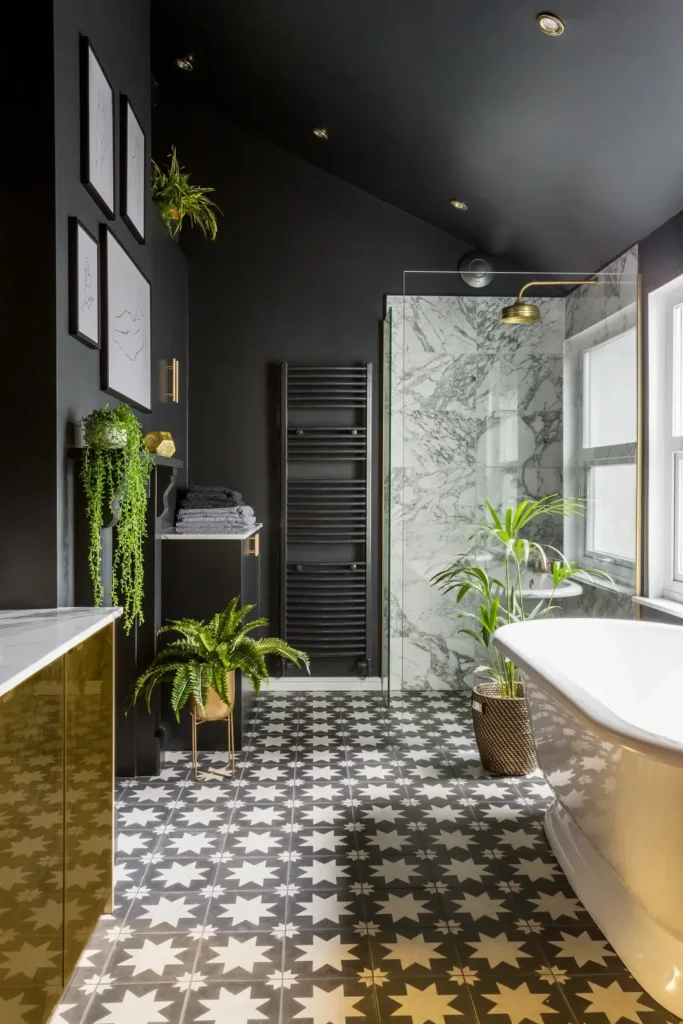
This one might be my personal favorite in the collection. All-black ceiling and walls in a deep charcoal with a subtle blue undertone, surrounding a pristine Arabescato marble shower enclosure. That tension — rough, moody darkness against veined, elegant marble — is genuinely stunning.
Brass fixtures throughout the shower arm, towel rail, and shelf brackets connect those two very different worlds. Brass is warm, so it bridges the cool marble and the deep black walls without any friction.
The plants are doing more work here than decoration:
- A full Boston fern on a brass stand
- A tall tropical palm beside the freestanding tub
- Hanging string-of-pearls near the ceiling
Green against black is one of the most naturally occurring contrasts on the planet. It reads as lush rather than forced, and it gives the room oxygen it desperately needs.
The patterned black and white geometric star floor tile adds movement at ground level. The ceiling and walls are all one dark tone, and then the floor surprises you. That decision takes confidence. It completely pays off.
Also Read; Gorgeous Black and White Bathroom – 15 Decor Ideas and Timeless Styles
Black Marble Floors, Red Fixtures, and Art Nouveau Wallpaper
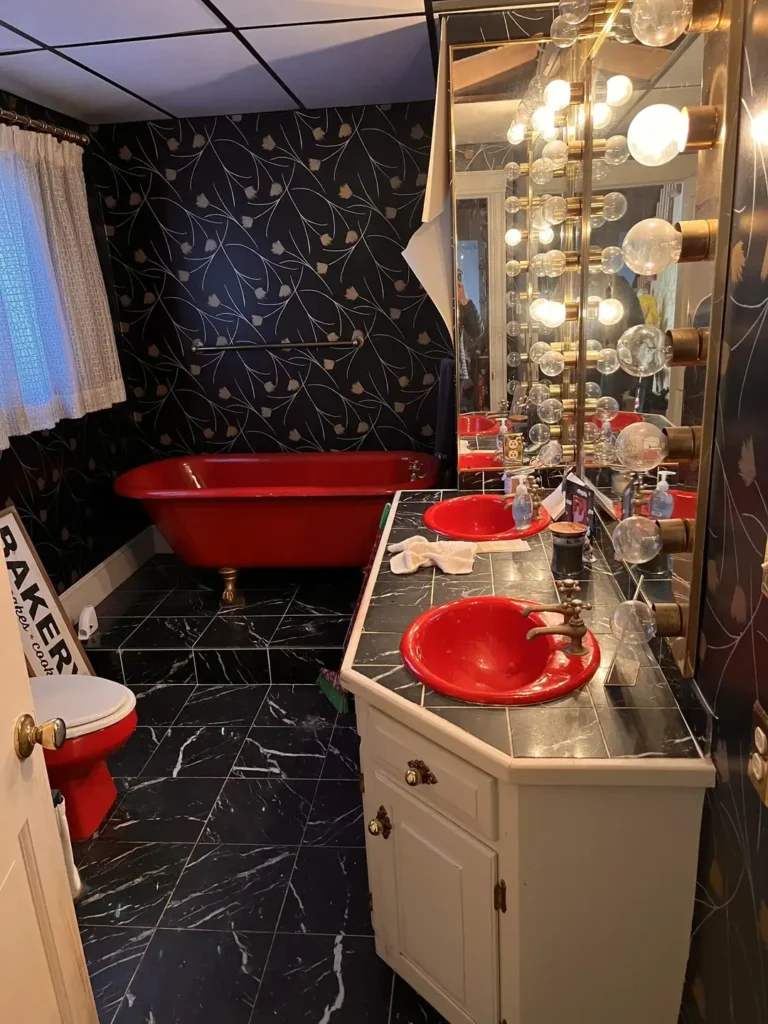
This bathroom is not for the timid. And that’s exactly why it’s worth talking about.
The foundation is already dramatic: black marble-effect floor tiles with white veining, dark floral wallpaper in navy and cream, and a mirrored vanity with globe pendant lights. Then someone added red. A lot of red. A red clawfoot bathtub, two round red pedestal sinks, and a red toilet.
On paper that sounds completely unhinged. In practice? It works because of the black.
Dark rooms handle bold accent colors far better than light ones. White or beige walls would have made those red fixtures look like a design emergency. The dark surroundings absorb the saturation and anchor it instead of letting it overwhelm the space.
The Art Nouveau-inspired floral wallpaper is the unifying element throughout. Its dark ground connects to the floor tiles, while the delicate vine pattern softens the visual weight. The brass globe pendant cluster reflected in the mirrored vanity multiplies the warmth and gives the whole space a theatrical, 1920s-salon quality. FYI, that’s a vibe.
The lesson here is commitment. One red sink on white walls looks like an accident. All red fixtures together, surrounded by deep black and dark wallpaper, reads as a design language. Half-measures would have killed this room.
Black Trim with Orange and Yellow Walls — A Combination Nobody Expected
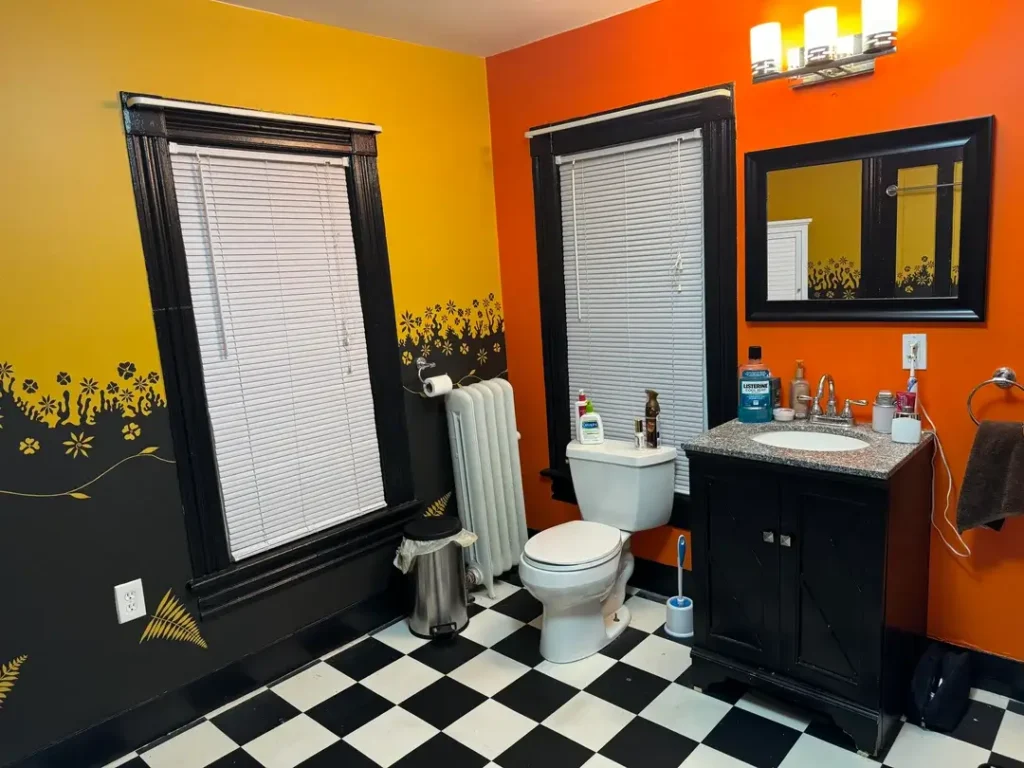
Full disclosure: this one isn’t technically a black bathroom. The walls are orange and golden yellow. But the black elements are so dominant that it belongs in any conversation about black bathroom ideas — and it teaches something really important.
Black works as a structural color, not just a wall color.
The window frames, baseboards, vanity cabinet, mirror frame, and lower wainscoting are all painted black. Against those vivid warm walls, those black architectural elements create sharp definition and stop the warm colors from bleeding into each other. The black-and-white checkerboard floor grounds everything.
The hand-painted black floral silhouette border along the transition between the yellow and black lower wall is the detail that lifts this from eccentric to considered. Someone spent real time on that. You can tell.
The big takeaway: if you’re not ready to paint your walls black, paint everything else. Black trim, black window frames, black vanity — you get much of the same visual weight as black walls, but with more flexibility to play with color elsewhere.
Black-Trimmed Plant Paradise with White Tiles and a Concrete Sink
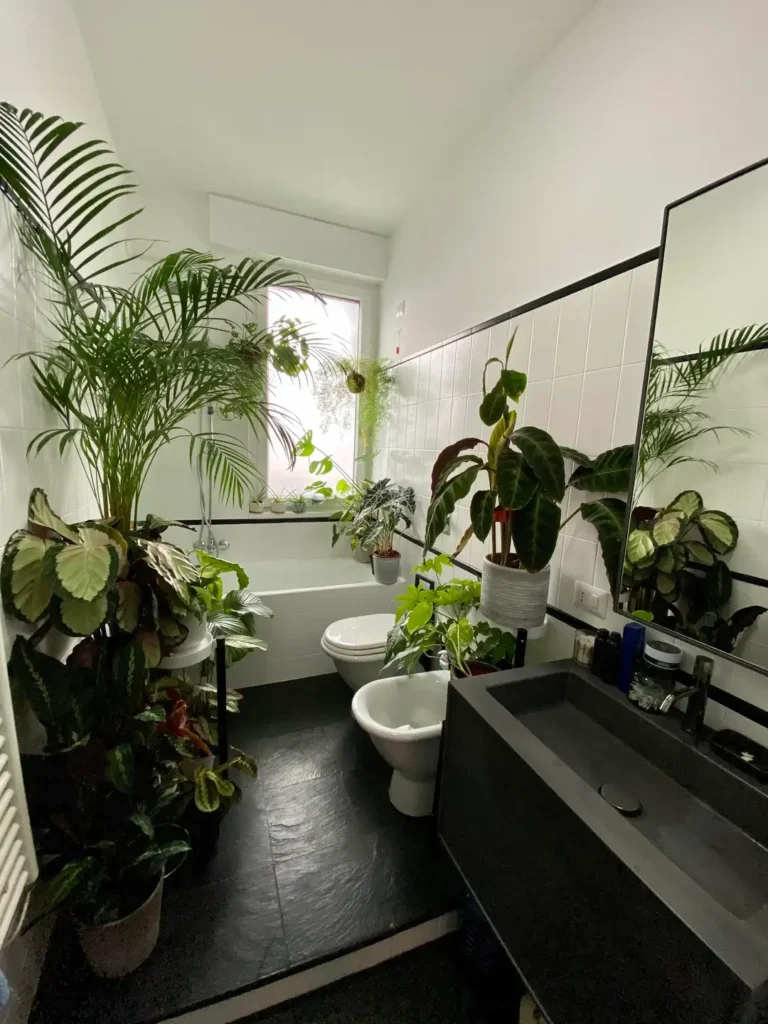
Most dark bathroom ideas lead with darkness as the primary move. This one flips the script entirely.
White tile walls. White ceiling. White toilet. But the matte black floor tiles, black-framed rectangular mirror, and gunmetal grey concrete trough sink define the entire character of the space. The black is in the details, not the walls — and somehow it’s just as impactful.
Every available surface has a tropical houseplant on it:
- A towering areca palm beside the tub
- A large rubber plant in the corner
- Calatheas at various heights
- Trailing plants hanging from the window edge
The black floor and concrete sink act as a dark anchor beneath all that green, giving the plants something to contrast against. Without those dark elements, the whole room would feel like a blank page.
This is proof that you don’t need to paint walls black to get a dramatic result. For anyone who loves plants but wants some design structure, this is genuinely the blueprint. White walls maximize light for plant growth. Black accents give the space its backbone.
Also Read: Black and Wood Bathroom Ideas: 15 Stunning Designs You’ll Want to Copy
Half Black, Half White with Beadboard, Steel-Frame Shower Screen, and Pressed Tin Ceiling
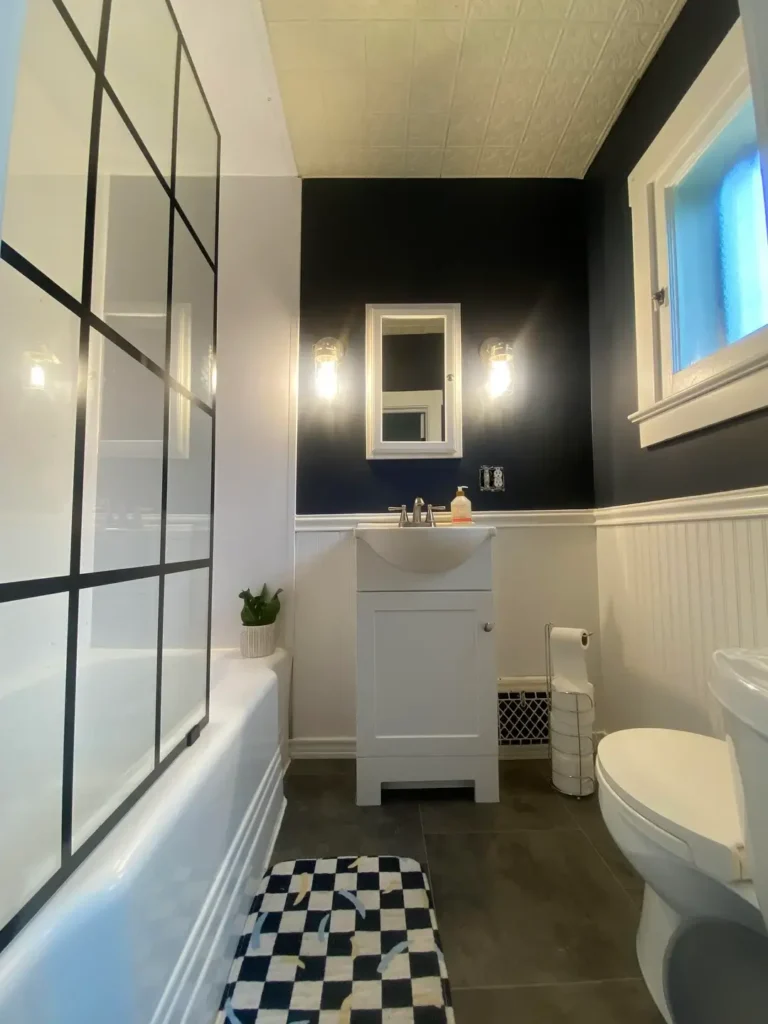
Splitting a bathroom between black upper walls and white beadboard wainscoting is honestly one of the most accessible ways to go dark without going all in. You get visual drama from the top half while the white lower portion keeps the space feeling light at eye level.
The smart secondary choices here are what really elevate it:
- A pressed tin ceiling adds historic texture overhead
- Steel-frame glass shower screen introduces an industrial detail that ties to the black walls
- Edison bulb sconces beside the white medicine cabinet cast warm light that softens the contrast
- A black-and-white checkered bath mat on the tub ledge connects both halves playfully
These small deliberate choices are exactly what separate a thoughtfully designed bathroom from one that just has dark paint.
Half-and-half works especially well in smaller bathrooms. The white lower half keeps the floor-level environment light, which prevents the space from feeling compressed. If you’re nervous about going dark in a small bathroom, start from chair rail height up. That’s genuinely the lowest-risk entry point.
Vintage Pink Tile Meets Dark Floral Wallpaper and Black Cabinetry
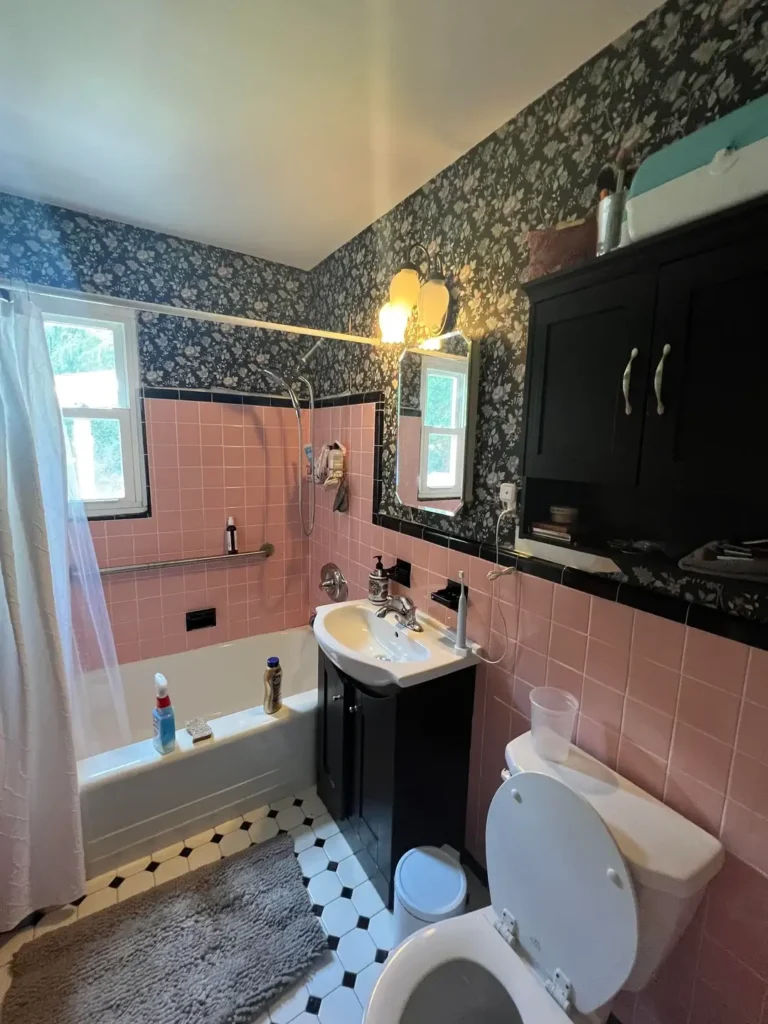
What do you do with a 1950s pink-tiled bathroom you can’t afford to retile? Most people either embrace the nostalgia or immediately start pricing out demolition. This homeowner found a third option — and it’s more interesting than either.
The original pink square tiles on the walls and floor stayed completely intact. The changes: dark navy floral wallpaper above the tile line, a black vanity cabinet, a black medicine cabinet, and black painted window and door trim. The result feels like a Victorian bedroom annexed a 1950s bathroom.
It genuinely shouldn’t work as well as it does.
The black accents do the unifying work. They define the edges, sharpen the contrast, and make everything within the space look intentional — the same way a dark picture frame makes a painting look finished. Pink tile, white fixtures, dark wallpaper, and plants — all held together by black trim.
If you’re working with existing colored tile you can’t change, this is your principle to apply. Don’t fight the existing color. Find a dark accent palette that embraces it. Pink and dark navy with black trim is one version. Teal tile with dark sage and black is another. The dark accents do the reconciling for you.
All-Black Shower Enclosure with Embossed Hex Tile and Herringbone Floor
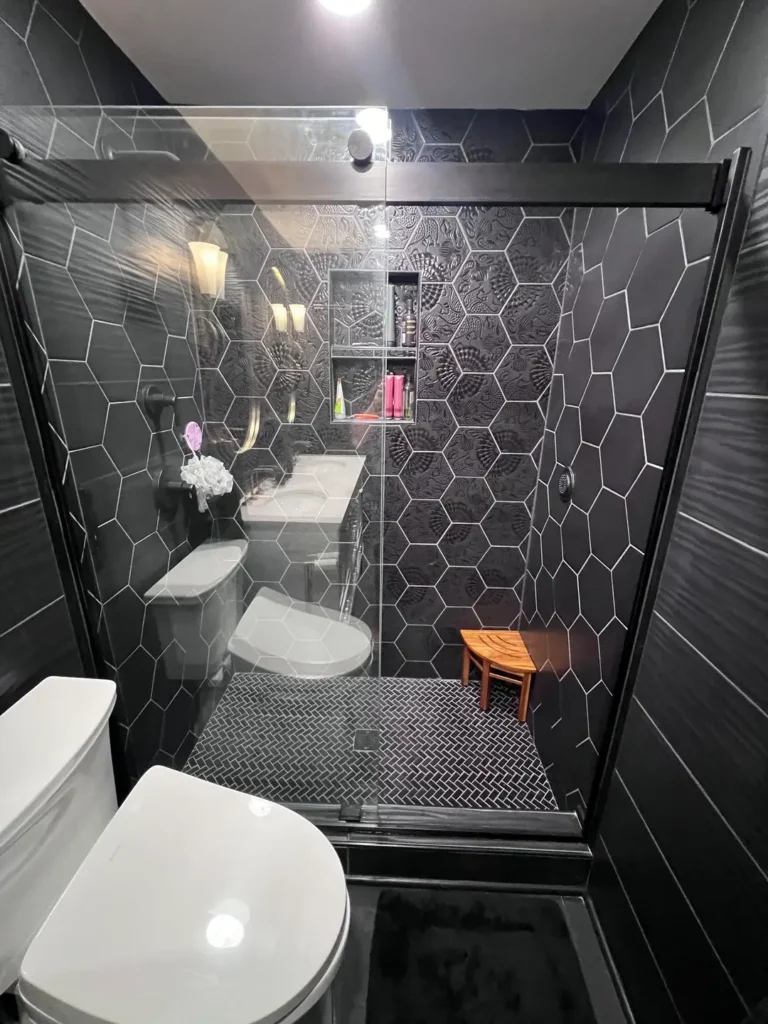
Getting an all-black shower enclosure right is where a lot of renovation projects either succeed or quietly fail. This one succeeds — and the reason is deliberate layering of tile patterns and textures within a single tonal palette.
Three distinct tile types work together in the same black-on-black shower:
- Large-format wave-textured rectangular tiles on the outer walls
- Embossed floral hexagonal tiles on the back shower wall
- Small herringbone mosaic tiles on the shower floor
Each surface is completely different in scale and texture, yet everything reads as cohesive because the color never changes. The clear glass sliding door with a matte black frame reveals all of that tile work rather than hiding it. A frosted door would have completely buried the layering that makes the shower the focal point.
Inside the shower, a small teak corner stool is the only warm-toned element in the entire enclosure. It stands out precisely because everything else is black. That one warm wood piece stops the shower from feeling sterile. Small detail. Huge impact.
What All 12 Black Bathrooms Are Actually Teaching You
Looking across all of these spaces, a few patterns show up consistently worth summarizing:
| Element | Why It Matters | Best Used With |
|---|---|---|
| Warm wood accents | Prevents cold, cave-like feel | Matte black walls, dark tile |
| Brass and gold fixtures | Adds warmth, bridges dark and light | Any black bathroom |
| Layered tile textures | Creates visual interest within a dark palette | All-black showers and walls |
| White beadboard or lower walls | Keeps floor-level environment light | Smaller bathrooms |
| Indoor plants | Introduces organic contrast against black | Any style of black bathroom |
| Pattern flooring | Grounds the space with movement | When walls are all one dark tone |
The question most people ask before going dark is whether they’ll regret it. Based on these 12 examples? The people who regret it are the ones who go halfway. One dark accent wall in a room that fights against it, or dark paint without thinking through the lighting first — those are the regrets.
Full commitment, or a carefully considered partial approach with strong anchor points, tends to produce results people actually keep for years.
Final Thoughts — Should You Actually Do It?
Black bathrooms feel different from other rooms. Not worse. Different. There’s a reason people keep coming back to this look even though every conventional rule tells them not to.
The homeowners in this list ignored the advice, committed to their choices, and ended up with bathrooms that feel genuinely designed rather than defaulted into. Some spent a lot. Some spent almost nothing. The common thread was intentionality, not budget.
So if you’ve been sitting on the fence about going dark, pick one element from this list that resonates and start there. Your lighting. Your floor tiles. Your trim color. One strong decision usually unlocks the rest.
What do you think — are you team all-black or more of a “just the trim” kind of person? Either way, you’ve got the blueprint now. Go make something interesting. 🖤